
Verbal-only patient rounds lose critical information between shifts. A structured rounds template ensures every hospitalized patient gets consistent documentation of their status, interval events, and updated care plan.
This template standardizes what gets captured during daily rounds, whether your team rounds once in the morning or multiple times across emergency shifts. It works for general practice, critical care, specialty hospitals, and large animal settings.
Download the template below and customize the fields to match your workflow. Use it as a printable sheet for bedside rounds or adapt it for your practice management system.
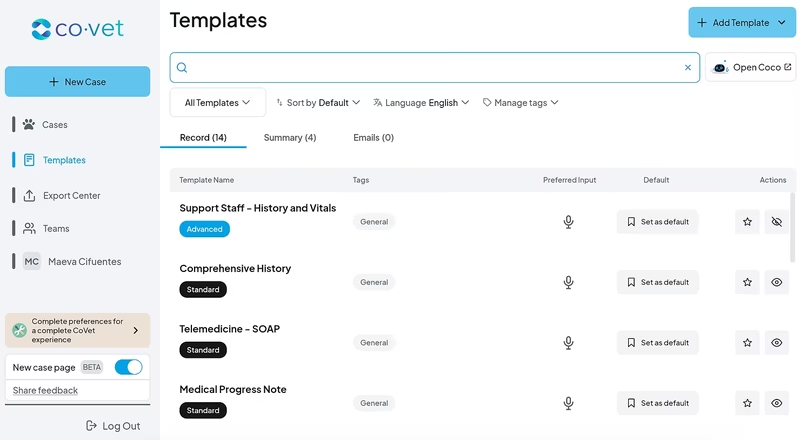
✨ Turn spoken rounds into structured recordsSave this template to your CoVet account and start using it today CoVet captures your team's verbal updates during rounds and organizes them into complete, structured documentation. Talk through each patient's status and CoVet fills in the template automatically. Want to customize the template first? Use CoCo, our AI template builder, to add fields, modify sections, or adapt the format to match your rounding workflow. |
Check out our other veterinary templates
What a patient rounds template covers and why it matters
A patient rounds template is a structured document used during daily or shift-based rounds to review each hospitalized patient's status, update the care plan, and communicate across the team. It organizes the clinical discussion so nothing gets missed between shifts.
This is different from a treatment sheet, which tracks what was already done. The veterinary treatment template records medications given, procedures performed, and tasks completed. A rounds template structures the discussion and decisions about what happens next.
Without a standardized format, rounds default to ad-hoc verbal updates. Communication problems played a contributory role in 80% of settled cases of alleged veterinary professional negligence. A medication dosage that was supposed to be increased might remain unchanged, resulting in suboptimal treatment and delayed recovery. In one documented case, a nurse's annotation noting 'bloated abdomen' was not noticed in a patient developing peritonitis.
Communication errors during patient handoffs are frequent and patients commonly experience harm as a result. Structure prevents this. When rounds happen with a template, the same information gets reviewed for every patient, every time.
Document type | Primary purpose | When it's used | What it captures |
Rounds template | Structure clinical discussion and update care plan | During daily or shift-based rounds | Patient status, interval events, current vitals, updated plan for next 12-24 hours |
Treatment sheet | Track completed tasks and administered treatments | Throughout the day as tasks are performed | Medications given, procedures done, monitoring completed |
SOAP note | Document full clinical reasoning and medical record | At admission, significant changes, or discharge | Subjective findings, objective data, assessment, detailed plan |
Discharge summary | Communicate care provided and home instructions to client | At patient discharge | Diagnosis, treatments performed, medications to continue, follow-up recommendations |
What to include in a veterinary patient rounds template
A rounding template only works if it captures the right information. Each section below serves a specific purpose in keeping the care team aligned and preventing gaps in patient care.
Patient identification and case summary
Patient name, species, breed, age, weight, case number, admitting DVM, admitting date, primary diagnosis or problem list. This header gives any team member enough context to round on the patient without reviewing the entire record. When a vet picks up a hospitalized case mid-shift, these identifiers answer the immediate questions: who is this patient, why are they here, and who admitted them.
Overnight and interval events
What happened since the last round: new clinical signs, changes in vitals, appetite, attitude, urination, defecation, vomiting. Structured fields prevent this section from becoming a freeform paragraph that varies by author. One tech writes "patient doing well" while another documents "ate 50% of meal, urinated 2x, no vomiting." The template forces consistency.
Interval event field | Why it matters for rounds |
Appetite | Differentiates true anorexia from picky eating, tracks response to appetite stimulants |
Urination/defecation | Monitors fluid therapy effectiveness, GI function, post-op recovery |
Vomiting/regurgitation | Flags medication intolerance, disease progression, aspiration risk |
Attitude/mentation | Earliest indicator of clinical deterioration or improvement |
New clinical signs | Ensures emerging problems don't get lost between shifts |
Current vitals, monitoring parameters, and pain scoring
TPR, blood pressure, SpO2, pain score, weight trend, fluid balance. Specify which pain scale the practice uses so scores are comparable across shifts. The Colorado State University pain scales exist for both dogs and cats and are widely used as teaching tools. The Glasgow Composite Measure Pain Scale has been validated for dogs, and a feline version exists for cats. The veterinary physical exam template covers standardized vitals documentation.
Medication review, diagnostics, and plan update
Current medications with dose, route, frequency, last and next administration. Discontinued meds and rationale. Pending labs or imaging, results received, interpretation.
Assessment and updated plan for the next 12 to 24 hours. This is the highest-value section and the one most likely to be incomplete when rounds happen without a structured format. The plan is where clinical reasoning lives. Without it, the team knows what happened but not why or what to do next. Vet SOAP notes document the full assessment and plan at admission, but the rounds template keeps that plan updated daily.
Client communication and disposition
Last client update: date, time, who communicated, key points discussed. Consent pending. Next scheduled update.
Current disposition (stable, guarded, critical), estimated discharge date, discharge criteria. This section creates accountability. If no one documents who called the owner or what was said, the next shift either skips the update or repeats the same information. Tracking discharge criteria prevents the "when can my pet go home" question from catching the team off guard. The veterinary discharge instructions template builds on the rounds documentation to create clear owner communication.
Adapting the template by practice type
Practice type | Rounding frequency | Key adaptations |
General practice/short-stay | Simplified template focused on overnight events and same-day discharge planning | |
Emergency/critical care | Twice daily at 8 AM and 6-7 PM, plus technician rounds several times daily at shift changes | Expanded vitals section, fluid balance tracking, frequent plan updates |
Specialty/referral | Daily, often with case rounds involving multiple DVMs | Detailed diagnostics section, consultant recommendations field, multi-day plan |
Equine/large animal | Daily or twice daily | Offline-compatible format (paper or mobile), field for feeding/turnout instructions, farm contact info |
Veterinary efficiency improves when the template matches the workflow instead of forcing the workflow to match the template.
Common problems with rounding documentation and how to fix them
Rounding without a written format. Verbal-only rounds lose information between shifts. What one vet says out loud doesn't make it into the record, and the next shift has no reference point. Incomplete or inaccurate records are one of the most common veterinary recordkeeping violations. Fix: standardized template, even paper, to create accountability.
Inconsistent fields across shifts. Different formats per shift mean one tech documents pain scores and fluid totals while another skips both. Records that don't include all treatment provided, medications, or who is responsible for care create gaps no one can track across shifts. Fix: single template, standardized across the team.
Skipping the assessment and plan. Vitals get logged but clinical reasoning behind plan changes doesn't. The record shows the patient's temperature dropped but not whether antibiotics were adjusted or why. Fix: make assessment and plan mandatory before moving to the next patient.
No client communication tracking. Client communication documentation is an AAHA medical recordkeeping standard, but it still gets skipped. Morning shift calls with an update. Afternoon shift calls again with the same information because nothing was documented. Fix: communication log field on the template.
Rounds documentation disconnected from discharge. Rounds happen daily but discharge summaries are rebuilt from scratch. Delayed record updates waiting hours or days compromise patient safety and team communication. The vet writing discharge instructions has to dig through treatment sheets instead of pulling from organized rounds notes. Fix: use cumulative rounds entries as the backbone for the discharge record. The veterinary SOP template can help standardize this workflow across the practice.
Automating your patient rounds template
A downloadable template standardizes what gets documented, but entries still need to be completed manually during or between a fast-moving discussion. When rounds move quickly, filling out structured fields falls behind.
CoVet is an AI veterinary scribe that captures spoken clinical updates during or after rounds and turns them into organized documentation. Instead of stopping to type or write between patients, the team discusses each case out loud and CoVet structures those spoken updates into complete rounds records.
The platform includes customizable templates developed by veterinarians, plus an AI template builder called CoCo that can create a rounding format specific to your practice workflow. Whether your team rounds once daily or multiple times per shift, the template adapts.
Records sync directly to your practice management system through integrations or the CoVet Chrome Extension, so rounds documentation flows into the patient record without manual transfer.
Frequently asked questions about patient rounds templates
How does a patient rounds template differ from a veterinary treatment sheet?
A patient rounds template structures the clinical discussion about what happens next for each hospitalized patient, capturing interval events, current status, assessment, and the updated plan for the next 12 to 24 hours. A veterinary treatment sheet tracks what was already done, recording medications administered, procedures completed, and tasks finished throughout the day. The treatment sheet is a task log while the rounds template is a decision-making tool used during shift handoff to communicate clinical reasoning and guide inpatient documentation.
How often should veterinary teams conduct patient rounds for hospitalized animals?
Rounding frequency depends on practice type and patient acuity. General practice and short-stay hospitalization typically runs once daily, usually in the morning, while emergency and critical care facilities round twice daily at 8 AM and 6 to 7 PM, with additional technician rounds several times throughout the day at shift changes. Specialty and referral hospitals often conduct daily rounds involving multiple DVMs and specialists for complex cases requiring coordinated care, with the goal of veterinary inpatient monitoring matching patient needs and workflow demands.
Should veterinary technicians and veterinarians use the same rounding template?
Yes, using the same template across the entire care team ensures consistency and prevents information gaps. Veterinary technician documentation during rounds focuses on observable interval events, vitals, treatments completed, and client communication, while veterinarians add the assessment and plan sections requiring clinical judgment. When both roles document in the same template, the full picture of patient status lives in one place, making team-based rounding more efficient, and SOAP notes follow the same principle by separating observable data from clinical interpretation.
Can a patient rounds template be used for outpatient follow-up visits?
A rounds template is designed for hospitalized patients who need serial assessment and plan updates over multiple shifts, so it wouldn't be the right fit for outpatient follow-up visits. For recheck appointments and outpatient follow-up, a veterinary physical exam template combined with a standard SOAP note works better because the physical exam template captures vitals and examination findings while the SOAP note documents the updated assessment and plan for that single discrete visit, not the continuous monitoring structure a rounds template assumes.
How do you standardize rounding documentation across a multi-location veterinary practice?
Standardizing across multiple locations requires a shared template that all locations use, a veterinary SOP defining what gets documented and when, consistent training during onboarding with periodic refreshers, and regular audits to check for completeness and rounding compliance. For multi-location veterinary practices using shared practice management systems, digital templates with required fields enforce standardization automatically, while manual or paper-based systems require more active oversight and audit sharing across location managers.
What is the best format for a veterinary patient rounds template: digital or paper?
Both work, but digital offers advantages for searchability, completeness, and integration with practice management systems. A digital rounding template built into your PMS ensures required fields get completed, timestamps entries automatically, and syncs with treatment sheets, while printable rounds sheets still have a place in settings where computers aren't practical during rounds like critical care units with bedside rounding or large animal practices. EHR integration is the deciding factor: if your PMS supports structured rounding documentation and the team can access it during rounds, digital wins, but if not, a well-designed printable template with a defined veterinary documentation workflow for getting data into the permanent record is the next best option.
About the Author
)
)
)