
Download a free veterinary discharge instructions template to standardize post-visit communication across your clinic.
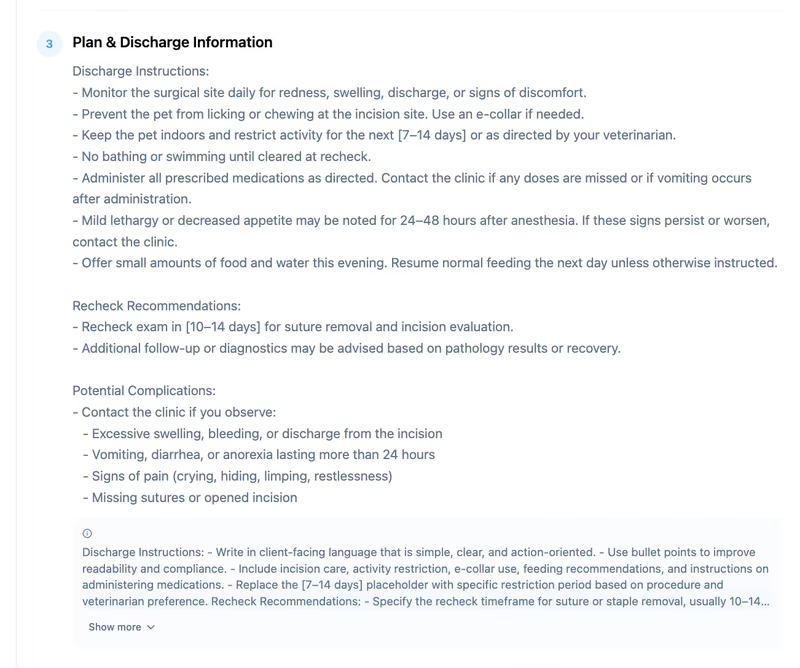
✨ Build your discharge instructions template with CoVetAI-assisted veterinary records, built by vets. CoVet's template library is built by vets, so the fields and workflows already reflect how real clinics operate. Save any template to your account and start using it with patients immediately. Want to customize it first? Use CoCo, our AI template assistant, to modify sections, add instructions, and tailor the format to your practice — all through a simple chat interface. |
CoVet has a growing database of veterinary templates. Check out other ones that might be helpful for you:
Automating Your Veterinary Discharge Instructions Template Template
Writing out discharge instructions by hand, or switching between records to copy details into a separate form, adds time to the end of every appointment. For busy clinics, that friction compounds quickly.
CoVet is an AI-powered scribe designed to reduce that overhead. During or after a visit, you speak through the patient's care details as you normally would, and CoVet structures everything into your preferred documentation format, including discharge instructions. Medication schedules, wound care notes, activity restrictions, follow-up timing, and emergency contact guidance are pulled from your clinical narrative automatically, so there's no separate data entry step.
The platform includes hundreds of customizable templates developed by the in-house medical team, and submitted by a global community of veterinary professionals. If your clinic has specific language for post-surgical patients, dental procedures, or multi-pet households, you can build those templates into CoVet using the AI-powered template builder or adjust existing ones to match how your team already communicates. Custom abbreviations further speed up documentation by converting common phrases automatically. Finished records sync directly to your practice management system via integrations or a Chrome Extension.
Documentation that keeps up with your day. CoVet turns your voice into structured exam records, no manual entry required.
Frequently asked questions about veterinary discharge instructions templates
Clear post-op instructions for dogs and other patients should let an owner manage recovery at home without calling the clinic.
What information should veterinary discharge instructions include for post-surgical patients?
Post-operative care instructions need to be specific enough that a pet owner can follow them without calling the clinic, while still being clear and easy to read under stress.
A thorough discharge template for post-surgical patients should cover medication instructions with dosing times and duration, wound care instructions including how to clean the site and what signs of infection look like, activity restriction guidelines specifying what the animal should not do and for how long, suture removal instructions with the scheduled date or criteria, follow-up appointment instructions, feeding instructions for the day of and days after surgery, hydration instructions, pain management instructions including what to monitor and when to escalate, and an after-hours emergency contact.
Templates that include checkboxes or structured fields for each of these sections reduce the chance that a staff member skips a section under time pressure. They also give the client a reference document they can return to rather than relying on verbal instructions given while managing a groggy pet. Discharge content flows more easily when it is built from the same record as your veterinary SOAP template.
For more on structuring clinical documentation, see our guide to vet SOAP notes.
How do digital veterinary discharge instructions improve client compliance compared to handwritten notes?
Handwritten notes create two problems: legibility and completeness. Under a busy caseload, handwritten home care instructions are often rushed, abbreviated, or missing sections. Even when complete, clients may struggle to read them at home.
Digital discharge instructions remove both issues. A structured discharge template ensures that every field is accounted for before the document is finalized. Printable discharge instructions formatted clearly, with medication times, warning signs, and follow-up dates in distinct sections, are easier for clients to follow without calling back for clarification.
The difference in client communication quality is measurable. Studies in veterinary compliance research have consistently found that written instructions outperform verbal-only handoffs, and structured written instructions outperform unstructured ones. For clinics that send digital discharge instructions via email or SMS, clients also have a searchable, accessible record they can pull up at home rather than hunting for a printed sheet.
Practices focused on pet owner compliance increasingly treat discharge documentation as a clinical tool, not just an administrative formality. The same shift from handwriting to structure applies to printable veterinary exam forms used earlier in the visit.
Can veterinary discharge templates be customized for different procedures like dental cleanings or spays?
Yes, and procedure-specific templates are worth building out separately. A general discharge form works as a catch-all, but procedure-specific templates save staff time and reduce the chance of irrelevant or missing sections.
For dental cleanings, customized discharge instructions typically emphasize diet recommendations for the day of and following days, oral home care instructions, and guidance on monitoring gum healing. For spays, the focus shifts to incision monitoring instructions, activity restriction guidelines, and post procedure notes about normal versus abnormal swelling or discharge.
Keeping a library of case discharge plans by procedure type also protects consistency. When a different team member handles discharge for a common procedure, a purpose-built template means the instructions are standardized, not dependent on what that individual remembers to include.
CoVet's CoCo template builder lets you create and save as many procedure-specific discharge forms as your clinic needs. You can build them from scratch or adapt existing templates, and the finished discharge form populates automatically from your clinical notes.
What are the legal documentation requirements for veterinary discharge instructions?
Requirements vary by state and jurisdiction, but most veterinary medical records standards share common expectations for what constitutes a complete and defensible patient record. A complete veterinary discharge summary is also the record you would rely on if an outcome is ever questioned.
Discharge documentation that meets typical documentation standards should include patient identification, the date of the visit and treating veterinarian, the assessment and treatment performed, a copy or summary of all medication instructions and prescriptions issued, home care instructions given to the client, follow-up recommendations, and a record of client education provided.
A discharge summary template that captures all of these fields creates a record that can be referenced in the event of a complaint, adverse outcome, or audit. Veterinary contact information should appear clearly on every discharge document so clients know who to call and when.
Some states require that medical records, including discharge documentation, be retained for a minimum number of years and that they be legible, dated, and attributable to the clinician who authored them. For a fuller overview of documentation standards, see our guide to veterinary medical records laws.
How do veterinary discharge instruction templates integrate with practice management software?
Integration between discharge templates and practice management systems eliminates the double-entry problem that slows down most discharge workflows.
Without integration, a technician completing discharge documentation has to pull information from the patient record, transfer it into a discharge form, and then potentially log the completed form back into the system separately. That process creates room for transcription errors and adds time to every appointment.
Modern veterinary workflow tools, including CoVet, integrate directly with practice management software so that the patient record and discharge template share a single source of information. Automated documentation means the relevant clinical details, including medications prescribed, procedures performed, and follow-up timing, are already populated when the discharge form is generated. Staff review and adjust as needed rather than building the form from scratch.
For clinics exploring digital discharge instructions as part of a broader operational overhaul, integration is often the feature that determines whether adoption sticks. See how CoVet's SOAP note automation software fits into your existing veterinary workflow.
What should discharge instructions include for multi-pet households with different medication schedules?
Multi-pet households present a real documentation challenge. When two or more animals from the same household leave with different prescriptions, home care instructions, or feeding restrictions, a single discharge sheet becomes confusing and potentially dangerous.
The clearest approach is to provide separate, clearly labeled discharge instructions for each patient, even when they belong to the same client. Each document should include that animal's name and species prominently, medication instructions with exact dosing times and quantities for that animal specifically, prescription label instructions and any warnings about cross-contamination or medication storage, feeding instructions that reflect that animal's post-visit dietary needs, and pain management instructions if relevant.
For households where animals may have access to each other's food or medication, it's worth adding explicit guidance in the home care instructions. Clients managing multiple pets at once benefit from clear, distinct documents over combined sheets where the per-animal details can blur together.
CoVet's multi-patient support creates separate records for multiple pets seen in the same appointment, which means discharge documentation stays patient-specific without additional work from the team.
About the Author
)
)
)