
Standardize dental documentation across your team with veterinary dental chart templates built for real clinical workflows. CoVet's AI template builder is developed by vets, so the fields, numbering systems, and charting structure already reflect how dental procedures actually get documented.
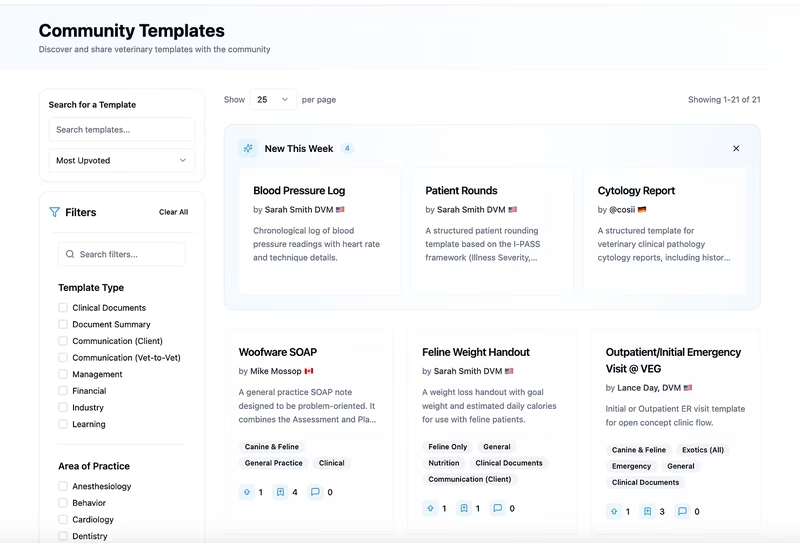
✨ Build your veterinary dental chart template with CoVetAI-assisted veterinary records, built by vets. CoVet's template library is built by vets, so the fields and workflows already reflect how real clinics operate. Save any template to your account and start using it with patients immediately. Want to customize it first? Use CoCo, our AI template assistant, to modify sections, add instructions, and tailor the format to your practice — all through a simple chat interface. |
Understanding the Modified Triadan Numbering System
Consistent tooth identification starts with a shared numbering system, and the Modified Triadan System is the standard most veterinary dental charts are built around. Each tooth gets a three-digit number: the first digit identifies the quadrant, and the second two digits indicate the tooth's position moving from rostral to caudal within that quadrant.
Quadrants 1 through 4 refer to permanent teeth (upper right, upper left, lower left, lower right), while quadrants 5 through 8 cover deciduous teeth in the same order. Two patterns worth noting are what's sometimes called the Rule of 4s and 9s: the canine tooth is consistently numbered 04 in its quadrant (104, 204, 304, 404), and the first molar is consistently 09. This makes it straightforward to orient the chart regardless of species or whether you're working with adult or juvenile patients.
For practices newer to structured dental charting, building familiarity with the Triadan system tends to make documentation faster and more consistent across the team. It's also the foundation that makes veterinary practice management tools and templates interoperable, since everyone is referencing the same tooth identification framework.
Essential Elements of a Veterinary Dental Chart
A thorough veterinary dental chart goes beyond a simple tooth diagram. The sections that commonly appear in well-structured charts include:
Patient identification: signalment, medical history, and any relevant systemic conditions that could affect anesthesia or healing
Graphical tooth representation: a crown and root diagram for both arches, with space to mark findings at the individual tooth level A feline dental chart pre-populated for 30 teeth keeps charting accurate by leaving out teeth cats do not have.
Periodontal findings: probing depths at multiple points per tooth, gingival margin level, furcation involvement, mobility classification, and plaque and calculus indices
Pathology documentation: space to note fractures, tooth resorption, abrasion, wear patterns, and other abnormalities using standardized abbreviations
Treatment record: procedures performed, including extractions, professional cleaning, root canal treatment, and any restorations
Radiographic findings: notes linked to specific teeth, since radiographs often reveal pathology not visible on oral exam alone
Anesthesia monitoring: a log of vital signs and monitoring parameters during the procedure
Home care and follow-up: client instructions and any recheck recommendations
Having all of these elements in a single chart keeps the dental record self-contained and makes it easier to reference findings at future visits. For practices thinking about how dental documentation fits into the broader record, veterinary medical records laws offers a useful overview of what's generally expected in a complete patient file.
AVDC-Approved Dental Charting Abbreviations
Standardized abbreviations help keep dental charts readable across team members, especially when multiple people document the same procedure. The American Veterinary Dental College (AVDC) has published a set of abbreviations that are widely referenced in veterinary dental charting. Common categories include:
Periodontal staging: GI1-3 for gingivitis index, PD1-4 for periodontal disease staging, F1-3 for furcation involvement, M1-3 for mobility classification
Tooth pathology: FX for fracture, TR for tooth resorption, AB for abrasion, AT for attrition, CC for caries
Procedures: EXT for extraction, PRO for professional cleaning/scaling and polishing, RC for root canal treatment, AM for dental radiograph
Using consistent abbreviations across the practice makes it easier to review charts, train new staff, and identify patterns over time. This is one area where digital templates tend to have an advantage over paper, since dropdown fields and auto-complete can reinforce correct notation without requiring staff to memorize every code. Building dental charting into a veterinary SOP template helps the whole team document the same way. For a broader look at how documentation tools are evolving, AI vet tools covers some of the options practices are currently exploring.
How to Complete a Veterinary Dental Chart Step-by-Step
A systematic approach to dental charting helps ensure nothing gets missed, particularly during procedures where attention is divided between clinical work and documentation. A two-person team, with one examining and one recording, tends to make the process more efficient and reduces transcription errors.
A commonly used workflow follows this general sequence:
Complete patient identification and confirm signalment, weight, and relevant history before anesthesia induction
Assess extraoral structures: lymph nodes, jaw symmetry, muscles of mastication, and any facial swelling or asymmetry
Count and identify teeth systematically, starting at quadrant 1 (upper right) and moving through each quadrant in order
Use a dental explorer to check for mobility and enamel defects at each tooth
Probe the gingival sulcus at four to six points per tooth, recording depth in millimeters and noting any bleeding on probing
Document all findings using standardized abbreviations as you go, rather than at the end of the procedure
Note radiographic findings for each tooth or region, cross-referencing with the graphical chart
Record procedures performed, including which teeth were treated and what was done
The goal is a chart that someone reviewing the record months later can follow without needing to ask questions. The same clarity standard applies to veterinary SOAP notes across the rest of the record. This is one reason practices increasingly look at dictation vs transcription workflows for dental documentation, since speaking findings aloud while charting can reduce the cognitive load of switching between examining and writing.
Canine vs. Feline Dental Charting Differences
A canine dental chart covers 42 permanent teeth, so the layout needs space the feline version does not. Canine and feline dental charts share the same Triadan framework, but the species differences are significant enough that most practices use separate chart formats for each.
The most immediate difference is the dental formula. Dogs have 42 permanent teeth; cats have 30. Several teeth present in dogs are absent in cats entirely, including 105, 205, 106, 206, 107, 207, 110, 210, 306, 406, 307, and 407. A feline chart pre-populated without these teeth avoids confusion during charting and reduces the chance of documenting a finding on a tooth that doesn't exist.
Normal probing depths also differ: dogs generally stay under 3mm in a healthy sulcus, while cats are typically under 1mm. What would be borderline in a canine patient may indicate significant disease in a feline patient, so the reference ranges on the chart matter.
Pathology patterns tend to differ too. Cats are more prone to tooth resorption (TR) and stomatitis, while dogs more commonly present with calculus accumulation and periodontal disease from incomplete home care. Having species-specific charts that reflect these tendencies helps orient the clinician's attention during the exam. For practices thinking about how to structure documentation across different visit types, veterinary SOAP template frameworks offer a useful reference for how to organize clinical findings consistently.
Automating Your Veterinary Dental Chart Template
Paper dental charts work, but transcribing handwritten findings into the patient record after a procedure adds time at the end of an already long appointment. For practices looking to reduce that administrative burden, AI in veterinary medicine offers tools worth exploring.
CoVet is an AI-powered scribe that listens as you speak during or after a procedure and helps structure your findings into organized records. The platform includes 85+ customizable templates for different visit types, and CoCo, CoVet's AI template builder, makes it possible to build or modify templates to reflect your clinic's charting preferences, including dental-specific fields, without starting from scratch.
For practices interested in reducing documentation time more broadly, SOAP note automation software is one option worth exploring alongside dental-specific tools. See CoVet's full list of AI vet tools to get a sense of what might fit your workflow.
CoVet has a growing database of veterinary templates. Check out other ones that might be helpful for you:
Frequently Asked Questions About Veterinary Dental Charts
What is the Modified Triadan System and why is it important for dental charting?
The Modified Triadan System is a three-digit tooth identification method used as a standard across veterinary dental charting. The first digit identifies the quadrant the tooth is in, and the second two digits identify the tooth's position within that quadrant, moving from the midline outward.
Quadrants 1 through 4 cover permanent teeth, and quadrants 5 through 8 cover deciduous teeth in the same spatial order. The system's consistency is what makes it practical: the canine tooth is always 04 in its quadrant, and the first molar is always 09, regardless of species. This means a trained technician can orient any chart quickly without needing species-specific numbering guides.
Standardized tooth identification also matters for longitudinal tracking. When a finding is documented at tooth 307 in one visit and referenced again six months later, there's no ambiguity about which tooth is meant. For practices thinking about how dental records fit into the broader patient file, veterinary medical records laws covers what's generally expected in terms of record completeness and retention.
What information must be recorded on a veterinary dental chart?
A complete veterinary dental chart generally includes patient identification, a graphical tooth diagram for marking findings, periodontal data, pathology notes, a procedure log, and radiographic findings. Most charts also have sections for anesthesia monitoring, pain assessment, and home care recommendations.
The level of detail varies by visit type. A routine COHAT (comprehensive oral health assessment and treatment) typically warrants full periodontal charting at multiple points per tooth, whereas a brief oral exam during a wellness visit may only require a summary of findings and any referrals recommended.
What matters most is that the chart is consistent enough that someone reviewing it later can understand what was found and what was done, without needing to ask. For context on how documentation standards apply more broadly, veterinary medical records laws is worth reviewing alongside any state board guidance specific to your practice.
How do veterinary technicians properly record periodontal probing depths?
Periodontal probing involves inserting a calibrated probe into the gingival sulcus at multiple points around each tooth and recording the depth in millimeters. Most protocols call for four to six measurements per tooth, typically at the mesial, mid, and distal aspects of both the buccal and lingual or palatal surfaces.
The probe is walked gently along the sulcus rather than inserted at a single point, and the reading is taken where the probe tip meets resistance. Bleeding on probing is also noted, as it's a marker of active inflammation. Recordings are usually made aloud by the examiner while a second team member charts, which is why two-person dental teams tend to produce more complete records.
Normal sulcus depth is generally under 3mm in dogs and under 1mm in cats, though individual variation exists. Depths beyond these ranges often warrant further investigation, including dental radiographs. For practices thinking about how to build more efficient clinical workflows, veterinary efficiency covers approaches that apply to dental procedures as well as general practice.
What are the standard abbreviations for veterinary dental charting?
The AVDC has published standardized abbreviations that are widely used across veterinary dental records. Familiarity with these makes charts easier to read across team members and practices.
Periodontal findings are typically noted using GI1-3 (gingivitis index), PD1-4 (periodontal disease stage), F1-3 (furcation involvement), and M1-3 (mobility). Tooth pathology abbreviations include FX (fracture), TR (tooth resorption), AB (abrasion), AT (attrition), and CC (caries). Procedures are recorded as EXT (extraction), PRO (professional cleaning), and RC (root canal treatment), among others.
Having a chart legend that includes these abbreviations makes it easier for new team members to document correctly from the start, and reduces the likelihood of inconsistent notation across staff. Digital templates that use structured fields or dropdowns can reinforce correct abbreviation use without requiring staff to reference the legend each time. For a look at how AI-assisted documentation tools approach this kind of standardization, AI integration for clinical decision covers some of the ways these tools are being applied in practice.
Should veterinary practices use separate dental charts for canine and feline patients?
Separate charts are generally the more practical choice. Canine and feline dental formulas differ significantly, dogs have 42 permanent teeth and cats have 30, and a number of teeth present in dogs simply don't exist in cats. Using a canine chart for a feline patient creates gaps and potential for confusion during charting.
Normal probing depth reference ranges also differ by species, and the pathology patterns that warrant attention tend to differ as well. A feline-specific chart can reflect these differences in its layout and reference ranges, making it easier for the examining technician to orient findings correctly without needing to mentally adjust for species differences on a generic chart.
For practices building out their template library, species-specific dental charts are one of the more straightforward wins in terms of reducing documentation errors. CoVet's CoCo template builder makes it possible to create or adapt templates for different species without starting from scratch each time. For context on how documentation tools fit into broader practice operations, veterinary practice management covers the wider landscape.
How do you document missing, fractured, or extracted teeth on a dental chart?
Missing, fractured, and extracted teeth are typically documented directly on the tooth diagram using standardized symbols or abbreviations, with supporting notes in the pathology or procedure section of the chart.
A tooth that is congenitally absent or was extracted before the current visit is usually marked with a specific symbol on the diagram (commonly an X through the tooth) and noted as missing in the pathology section. A fractured tooth is marked with FX, often with a notation indicating whether the fracture is uncomplicated (enamel only) or complicated (pulp exposure). An extraction performed during the current visit is recorded as EXT in the procedure log, with the tooth number, the procedure performed, and any complications noted.
Radiographic findings often accompany these notations, since radiographs may reveal root remnants, bone loss, or pathology not visible on oral exam. Keeping the chart notation, the procedure log, and the radiographic record cross-referenced makes it easier to review at a future visit and gives a complete picture of the patient's dental history. For practices looking at how to make documentation more consistent across team members, SOAP note automation software covers tools that can support standardization in clinical record keeping more broadly.
About the Author
)
)
)