
Veterinary teams often find themselves stretched thin from back-to-back appointments and after-hours charting.
We think the answer is fewer, better meetings. Meetings pile up to fill gaps left by unclear documentation, messy handoffs, and communication breakdowns. We think the answer is fewer, better meetings combined with workflows that reduce the need to meet in the first place. When records are complete and accessible, when handoffs don't require verbal reconstruction, a lot of meeting time simply becomes unnecessary.
This article covers how to set the right meeting cadence for an overburdened team, make the meetings you keep actually useful, and find formats that energize rather than drain. We've also included specific ideas for daily huddles, weekly syncs, monthly improvement sessions, and low-pressure culture-building.
Your team didn't go to vet school to sit in meetings. Give them documentation tools that keep everyone aligned without pulling them away from patients.
Set the right veterinary staff meeting cadence for an overburdened team
Meetings pile up in most clinics because no one has defined which ones actually need to happen, how often, or who owns them. Your team is already stretched thin from back-to-back appointments and after-hours documentation. Unnecessary meetings can chip away at the energy they need
We think the fix starts with being intentional. Strip your meeting calendar down to what genuinely requires real-time conversation, then protect everything else. Shorter, purpose-driven formats can replace the hour-long catch-ups that leave everyone more tired than before.
Once your veterinary efficiency workflows actually work, once documentation happens in real time and handoffs are clean, you'll likely find that half the meetings you used to need simply disappear.
Identify which veterinary staff meetings are actually necessary
Not every meeting on your calendar deserves to be there. We think the meetings that genuinely matter fall into a few categories: safety and compliance updates, alignment on urgent cases or schedule changes, and team decisions that require real-time input. Everything else is worth questioning.
Try auditing your current meeting load. For each recurring meeting, run through a quick checklist:
Does this meeting have a clear, stated objective?
Does that objective require real-time discussion, or could it be a written update?
Do attendees leave with specific action items?
Would anything break if we canceled this for a month?
If you're unsure on more than one of these, the meeting may need to go or be reworked. Stronger veterinary documentation habits can reduce most recap-style meetings entirely because the information already exists in the record. No one needs to verbally reconstruct what happened with a patient if the notes are already complete.
Replace full-team veterinary meetings with targeted micro-meetings
Pulling everyone into a room doesn't always make sense when half the team is mid-appointment. Micro-meetings can work better: short, focused check-ins with only the people who need to be involved.
A few examples:
Case-specific huddle: DVM + tech, five minutes, before or after a complicated appointment
Scheduling check-in: PM + front desk, five minutes, to address gaps or bottlenecks
Shift handoff: Outgoing + incoming staff, five minutes, to flag urgent follow-ups
These smaller formats work especially well when your documentation is already solid. If case notes are complete and accessible, the micro-meeting can focus on decisions and next steps instead of reconstructing what happened.
Define ownership for who calls each veterinary team meeting
Ad-hoc meetings multiply when no one knows who's responsible for calling them. We think every recurring meeting type needs a clear owner, someone who decides when it happens, sets the agenda, and cancels it when there's nothing worth discussing.
Meeting type | Owner | Responsibilities |
|---|---|---|
Daily huddles | Lead tech or shift supervisor | Set priorities for the day, flag urgent cases, cancel if nothing to cover |
Weekly team syncs | Practice manager | Prepare agenda, keep it under 20 minutes, assign action items |
Case reviews | DVM on rotation | Select cases worth discussing, lead clinical conversation, document takeaways |
Ops or HR updates | Hospital manager | Schedule only when needed, communicate changes, field questions |
This kind of clarity prevents the "let's just get everyone together" impulse that drains time and energy. It also becomes easier to maintain when records are consistent and accessible. The owner doesn't have to chase down information before every meeting because it's already documented.
Establish predictable meeting timing to protect clinical flow
Meetings that pop up mid-shift force your team to mentally switch gears, which adds stress to an already demanding day. Predictable timing helps. When everyone knows that the daily huddle is at 7:45 AM and the weekly sync is Tuesday at noon, they can plan around it instead of getting pulled away unexpectedly.
A few timing patterns that tend to work:
Daily huddles: Before the first appointment or right at shift change
Weekly syncs: Same day and time each week, ideally during a natural lull like early afternoon
Monthly reviews: End of month, scheduled at least two weeks in advance
Predictability also keeps meetings short. When your team isn't scrambling to prep or catch up on what they missed, you can get in, align, and get out. Clinics already dealing with burnout in veterinary teams don't need another unpredictable demand on their time.
Make veterinary staff meetings useful instead of draining
A meeting can be short and still feel like a waste of time if it lacks focus. We think useful meetings share a few traits: a clear agenda, a hard stop time, and outcomes that people can actually act on. Without those, even a 15-minute check-in becomes another energy drain.
Much of what makes meetings feel pointless is catch-up chatter. Someone recaps a case, someone else fills in what they missed, and half the time is gone before anything productive happens. Better documentation solves most of this. When notes are complete and accessible before the meeting starts, you skip the recap and get straight to decisions.
Limit agenda items to what requires real-time discussion
Not everything belongs on a meeting agenda. We think the only items worth discussing live are those that require alignment, a decision, or input from multiple people at once. Status updates, case recaps, and FYIs can almost always move to a shared doc, message thread, or quick note in your PMS integration.
A simple filter before adding anything to the agenda:
Does this need input from the group? If yes, it belongs in the meeting.
Is this informational only? Send it in writing instead.
Could one person handle this and report back? Delegate it.
This keeps meetings focused on what actually requires the room. Everything else gets communicated asynchronously, which protects your team's time and keeps the agenda tight.
Keep veterinary staff meetings time-boxed
Set a hard stop time and stick to it. We think most clinic meetings can fit into 15 minutes or less if the agenda is focused. Daily huddles might need five. Weekly syncs rarely need more than 20.
Time-boxing can work because it forces discipline. You cover what matters, assign action items, and move on. If discussion runs long, table it for a follow-up or a one-on-one instead of holding the whole group hostage.
Meetings stay shorter when there's less catching up to do. Teams that keep documentation current don't need to spend the first ten minutes reconstructing what happened yesterday. That communication flow is already handled, which means the meeting can focus on what's next.
How CoVet helps:
CoVet captures medical records in real time as you speak, so documentation is complete before your next meeting even starts. No more verbal recaps or digging through incomplete notes. Your team walks in already aligned on what happened, which means you can focus on decisions and next steps instead of backfill.
Use engaging meeting formats that fit busy veterinary teams
Forced icebreakers and trivia games tend to fall flat when your team is already exhausted. We think the best meeting formats feel useful, not gimmicky. They give people a reason to pay attention without adding extra pressure.
A few formats that tend to work:
Wins round: Each person shares one thing that went well since the last meeting. Keeps it positive and takes under two minutes.
Micro-case share: One team member walks through a recent case in three minutes or less. Good for learning without a formal CE session.
Rotating facilitator: A different person leads the meeting each week. Keeps things fresh and builds ownership across the team.
One-question check-in: Start with a simple prompt like "What's one thing slowing you down this week?" Quick, focused, and useful.
These formats are easier to pull off when your team isn't mentally drained from chasing down documentation or fixing handoff errors. Lighter workflows create more space for genuine engagement.
Assign clear action items to drive follow-through
A meeting without action items is just a conversation. We think every meeting should end with a short list of who is doing what and by when. If you can't name those three things, it's worth asking whether the meeting needed to happen.
Effective action items share a few traits:
Clear owner: One person responsible, not "the team"
Specific deadline: "By Friday" beats "soon"
Visible tracking: Written down somewhere everyone can check
This structure creates a feedback loop. You can open the next meeting by reviewing what got done, which builds accountability and prevents the same issues from resurfacing week after week.
Consistent documentation helps here too. When action items live inside patient records or shared notes rather than someone's memory, nothing slips through the cracks between meetings.
Veterinary staff meeting ideas that don’t burn people out
The ideas below are intentionally low-effort. We think the best meeting formats for burnt-out teams are ones that don't require much prep, don't run long, and actually leave people feeling better than when they walked in.
None of these require a big culture shift or a dedicated "team building" budget. They're designed to fit into clinics that are already stretched thin. The lighter your workflow burden, the easier it is to run meetings that energize instead of exhaust. When documentation and handoffs aren't draining your team's time, there's more mental space for connection and alignment.
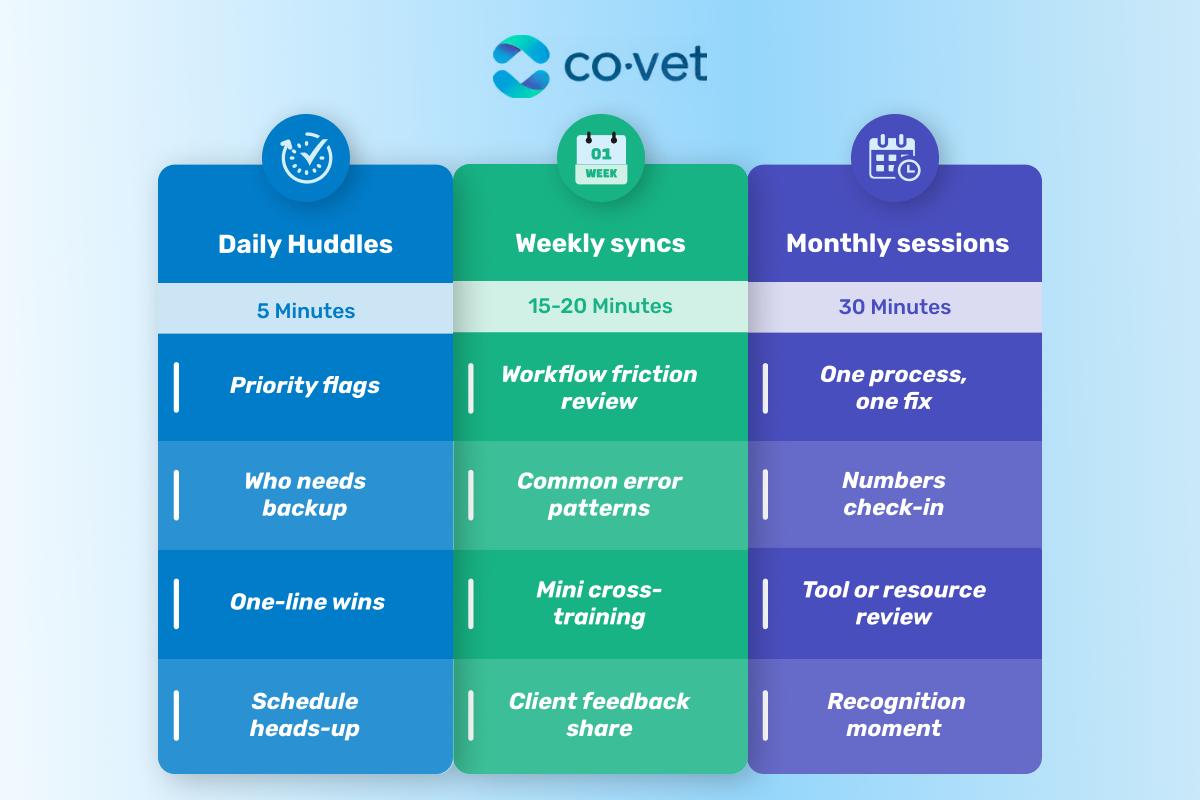
Ideas for daily or shift-start veterinary huddles
Daily huddles work best when they're fast and predictable. Five minutes at the start of a shift is enough to get everyone aligned without eating into appointment time.
A few ideas that fit the format:
Priority flags: Call out any high-risk patients, pending lab results, or tricky client situations for the day
Who needs backup: Quick check on who's overloaded and might need help
One-line wins: Each person shares a single thing that went well yesterday. Keeps morale up without dragging on
Schedule heads-up: Flag any gaps, double-bookings, or last-minute changes
Keep it standing-room only if possible. People stay focused when they're not settled into chairs. The goal is alignment and awareness, not discussion. Save deeper conversations for a different format.
Ideas for weekly veterinary team syncs
Weekly syncs give your team a chance to zoom out and talk about patterns instead of just putting out fires. We think 15 to 20 minutes is the sweet spot. Long enough to be useful, short enough to protect the schedule.
A few ideas worth trying:
Workflow friction review: What slowed us down this week? Pick one or two recurring issues and talk through fixes
Common error patterns: Flag mistakes that keep happening, like missed callbacks or documentation gaps, without blaming individuals
Mini cross-training: One person spends five minutes explaining something they do that others might not fully understand
Client feedback share: Read one positive review or flag one complaint worth discussing as a group
Rotate who leads these so it doesn't always fall on the PM. Shared ownership keeps the format from going stale.
Ideas for monthly veterinary improvement sessions
Monthly sessions are for stepping back and looking at systems, not just tasks. These don't need to be long, but they should be protected time where the team can think bigger picture without interruptions.
A few formats that work:
One process, one fix: Pick a single workflow that's been frustrating the team. Map it out, find the bottleneck, and decide on one change to test next month
Numbers check-in: Review a handful of operational metrics like appointment volume, no-show rates, or documentation completion. Keep it brief and focus on trends, not blame
Tool or resource review: Is there something the team has been asking for? A new piece of equipment, a workflow change, or something like SOAP note automation? Monthly sessions are a good time to evaluate
Recognition moment: Acknowledge one or two people who went above and beyond. Simple and takes two minutes
The key is keeping these focused on improvement, not status updates. One clear takeaway per session is better than a long list of to-dos.
Ideas for culture-building without forced participation
Mandatory fun doesn't always land the way it's intended. We think culture-building works better when it's woven into the rhythm of the day rather than treated as a separate event people have to show up for.
A few low-pressure ideas:
Gratitude round: At the end of a weekly sync, anyone who wants to can thank a colleague for something specific. No pressure to participate, but it tends to catch on
Small wins board: Physical or digital space where people can post quick wins. A successful surgery, a difficult client handled well, a good catch on a chart
Pet of the week: Someone shares a quick photo or story about their own pet. Light, easy, and gives people a mental break
Optional team lunch: Once a month, no agenda. Show up if you want, skip if you're slammed
These work better when your team isn't already drained from chasing documentation or staying late to finish notes. Reducing that admin burden, through tools or better workflows, does more for morale than any team-building exercise.
Meetings shrink when records are already done. CoVet handles documentation while you work so there's less to recap later.
How better veterinary workflows reduce the need for extra meetings
Many meetings exist because information got lost somewhere. A case wasn't documented clearly, a handoff fell through, or someone needed to ask a question that should have been answered in the chart. We think these are usually workflow problems that meetings get used to patch over.
Fixing the root cause tends to be more effective than optimizing the meeting itself. Real-time documentation, complete records, and clean handoffs reduce the gaps that create meeting demand in the first place.
This is where a tool like CoVet makes a difference. As a veterinary AI scribe, CoVet captures real-time medical records as you speak, so documentation is done before you leave the exam room. That changes what your meetings need to cover.
A few examples of meetings CoVet could help shrink:
Morning case recaps: Instead of verbally walking through what happened yesterday, the notes are already in the system. Your daily huddle becomes five minutes of priorities, not fifteen minutes of reconstruction
Shift handoff meetings: Outgoing staff don't need to explain each open case when customizable SOAP templates have already captured the details. Handoffs become a quick flag of urgent items only
"What did the client say?" check-ins: CoVet captures the full conversation, so techs and DVMs don't need to huddle after the fact to piece together what was discussed
Documentation backlog reviews: When records are completed in real time, there's no backlog to review. The weekly "catch up on charts" meeting disappears entirely
The result is fewer meetings overall, and the ones you keep are focused on decisions and alignment rather than information recovery.
Build a veterinary staff meeting culture that actually works
Fewer meetings that do more. That's the target. When your team knows which meetings matter, who owns them, and what each one is supposed to accomplish, the whole rhythm of the clinic improves.
We think the biggest lever is workflow, not facilitation. Fix the documentation gaps and handoff issues that create meeting demand in the first place, and you'll likely find that half your calendar clears itself. The meetings that remain become shorter, more focused, and less draining.
Your team didn't get into veterinary medicine to sit in meetings. Give them systems that keep everyone aligned without pulling them away from the patients and clients they're there to serve.
Your team didn't go to vet school to sit in meetings. Give them documentation tools that keep everyone aligned without pulling them away from patients.
Frequently Asked Questions About veterinary staff meeting ideas
What are the most effective veterinary staff meeting ideas for busy clinics?
The most effective veterinary staff meeting ideas are ones that stay short, have a clear purpose, and end with action items. We think formats like five-minute daily huddles, rotating facilitators, and micro-case shares tend to work well because they keep communication flow tight without pulling people away from patients for too long.
How often should a veterinary practice hold staff meetings without causing burnout?
There's no universal answer, but we think most clinics do well with a brief daily huddle, a 15 to 20 minute weekly sync, and a monthly session for bigger-picture topics. The key for an overburdened team is predictable timing and a willingness to cancel meetings when there's nothing meaningful to discuss.
What types of veterinary staff meetings are actually necessary for clinic operations?
We think the necessary meetings fall into a few categories: safety and compliance updates, alignment on urgent cases or schedule changes, and decisions that require real-time input from multiple people. Anything else, like status updates or case recaps, can usually move to written communication if your documentation is solid.
What are the benefits of using micro-meetings instead of full-team veterinary meetings?
Micro-meetings protect your team's time by involving only the people who actually need to be there. A five-minute huddle between a DVM and tech about a complicated case is more efficient than pulling the whole team into a room. This veterinary staff meeting structure keeps communication flow tight and reduces interruptions to clinical work.
How can veterinary staff meeting ideas support team morale in high-stress clinics?
Low-pressure formats tend to work best for morale. Things like gratitude rounds, small wins boards, or optional team lunches give people connection without adding pressure. We think staff engagement improves more when you reduce the admin burden that's draining your team than when you add team building activities on top of it.
What are good daily huddle ideas for improving communication in a veterinary clinic?
Good daily veterinary huddle ideas include flagging priority cases, identifying who needs backup, sharing one-line wins, and calling out schedule changes. Keep it standing-room only and under five minutes. The goal is awareness and alignment, not deep discussion. A tight meeting agenda makes these huddles useful without dragging on.
What weekly veterinary staff meeting ideas help reduce workflow friction?
Weekly team syncs work well for discussing patterns instead of putting out fires. Try formats like a workflow friction review, common error patterns discussion, or mini cross-training sessions. These staff meeting activities help with continuous improvement by catching recurring issues before they become bigger problems.
How can monthly veterinary improvement sessions help streamline clinic operations?
Monthly sessions give your team protected time to step back and look at systems. Formats like "one process, one fix" or a quick numbers check-in help you identify bottlenecks and assign clear action items. The goal is building a meeting culture focused on improvement rather than status updates.
How do better workflows reduce the number of veterinary staff meetings a clinic needs?
Many meetings exist to fill information gaps. When documentation is incomplete or handoffs are messy, you end up holding meetings just to reconstruct what happened. Stronger veterinary staff meeting structure starts with better workflows. Real-time documentation and clean handoffs reduce the gaps that create meeting demand in the first place.
What role does veterinary technology play in replacing unnecessary staff meetings?
Tools that capture documentation in real time can reduce entire categories of meetings. Case recaps, shift handoff meetings, and "what did the client say" check-ins all shrink when the information is already in the record. Veterinary technology like AI scribes handles the real-time documentation piece so your team can focus on veterinary meeting topics that actually require discussion.
About the Author
)
)
)