Veterinary staff scheduling is the process of assigning shifts, roles, and coverage windows to make sure the right people are in place when patients need them. Most clinics have the basics down—but schedules still fall apart because workflow variability makes it hard to predict how long things actually take.
This guide covers the fundamentals of building a schedule that works, along with the operational realities that tend to make or break it: documentation timing, role clarity, and the hidden friction that pushes teams into overtime. We think a lot of scheduling frustration comes from treating it as a standalone problem when it's really downstream of how the clinic runs day to day.
A lot of overtime traces back to notes that didn't get finished on time. CoVet helps capture documentation during the exam, not after the shift ends.
Why veterinary staff scheduling breaks down
Some scheduling chaos is just clinic life. Emergencies come in, appointments run long when a routine visit reveals something unexpected, staff call out sick. You can't schedule around that, and any system that promises otherwise is overselling.
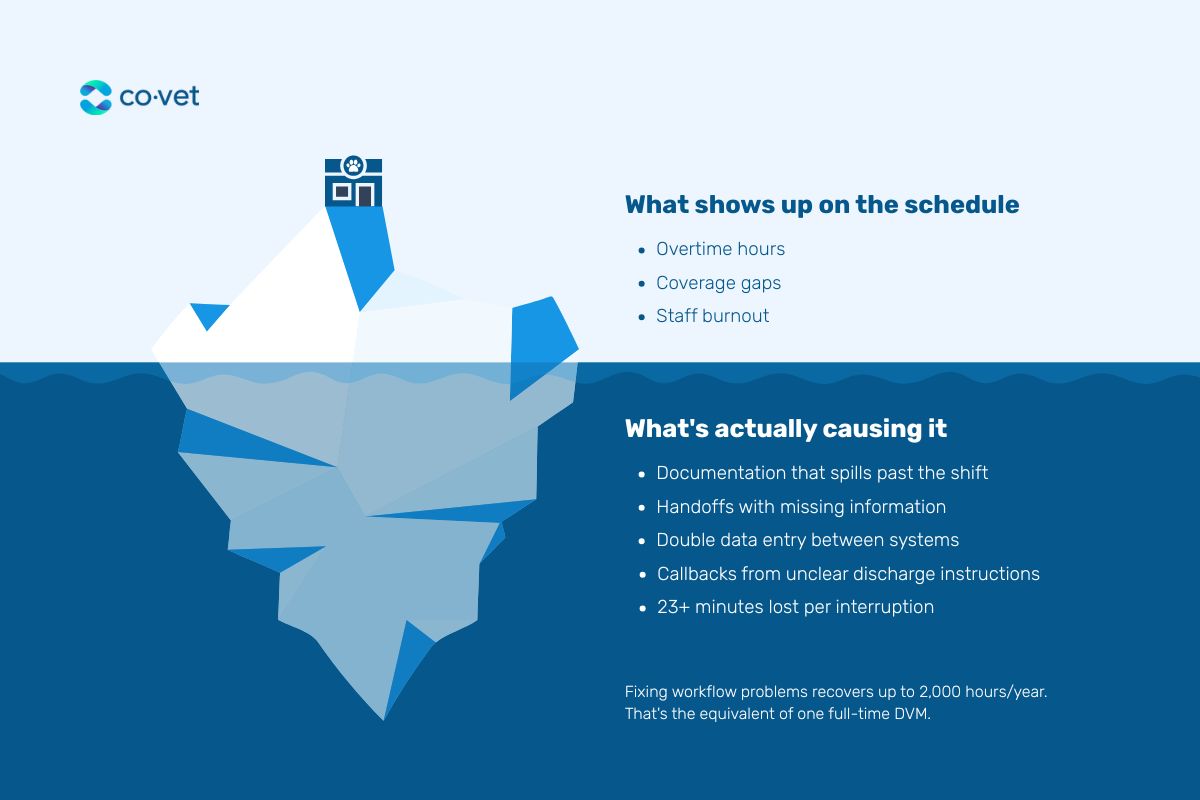
But a lot of the daily drift comes from preventable sources. Documentation that piles up because it didn't get finished in real time. Handoffs between shifts where critical details get lost or repeated. Tasks that fall through cracks because ownership wasn't clear. Rework from incomplete notes that require callbacks or chart corrections later. These patterns eat time in ways that don't show up on a staffing chart, but they inflate the hours your roster management has to cover.
We think the goal isn't eliminating unpredictability. It's reducing the preventable chaos so you have more capacity to absorb the inevitable kind. When your team spends less time on rework and catch-up, your schedule has more flexibility built in. Labor cost control gets easier when overtime isn't constantly filling gaps that better workflows could have prevented.
Building toward veterinary efficiency means tackling these preventable sources first, because that's where you actually have leverage.
The essentials every schedule must include
Any functional veterinary schedule needs a few building blocks in place. Before getting into the nuances of optimization, it helps to make sure these fundamentals are covered:
Element | What it defines | What to consider |
|---|---|---|
Coverage windows | When you need staff and how many | Appointment hours, walk-in availability, after-hours coverage |
Shift blocks | Who works when | Opening/closing duties, peak hours, overlap periods |
Role distribution | Staff mix per shift | DVMs, techs, support staff matched to expected case types |
Demand forecasting | Anticipated volume | Historical data, seasonal patterns, day-of-week trends |
These elements connect in a logical sequence:
Forecast demand → Define coverage windows → Build shift blocks → Assign roles
We think the clinics that get this right treat these elements as a baseline, not a finished product. They build the veterinary schedule around realistic timing for different visit types, prep requirements, and the admin work that happens between appointments. Veterinary practice management resources often cover these fundamentals well.
The challenge is that even solid shift assignments can drift when daily operations don't match the plan. The next section covers where that time actually gets lost.
Where clinics lose time inside the schedule
The minutes that derail a schedule rarely show up on a staffing chart. They accumulate in the gaps between tasks—and according to a study of 786 practices, fixing them can recover up to 2,000 hours per year. That's the equivalent of adding a full-time veterinarian without hiring anyone.
We think most practice managers are looking at the obvious stuff when the real problems are the patterns hiding underneath.
Documentation that doesn't happen in real time creates a cascade.
When notes get pushed to the end of the day, they don't just take longer—they create downstream problems. A colleague on the next shift has to re-gather information. A tech re-asks questions the DVM already covered. Research suggests DVMs spend 10+ hours per week on documentation catch-up when notes aren't captured during or immediately after appointments. That's a hidden shift most clinics don't account for.
Disconnected systems force double entry.
85% of practices report that their software doesn't integrate well with their PIMS. Every time someone manually transfers data between systems, you're paying for that task twice.
Interruptions cost more than the interruption itself.
Research from UC Irvine found it takes over 23 minutes to fully refocus after switching tasks—but clinic staff switch contexts every 10 minutes on average. When information isn't accessible or complete, people interrupt each other to fill gaps. Those "quick questions" don't just take 30 seconds; they fragment everyone's concentration.
Unclear discharge instructions generate callbacks.
Studies show clients only retain about 69% of what's discussed at discharge—dropping to 29-37% for details like medication side effects and activity restrictions. When clients don't understand instructions, they call back. Or they don't comply, and the patient returns with preventable complications. Either way, you're doing the work twice.
Analysis of 4.2 million clinical visits found that low-efficiency practices lose 8-15 minutes per appointment compared to their high-performing peers. We believe those minutes come primarily from handoff friction, documentation debt, and the invisible cost of fragmented attention—not from scheduling decisions.
Tools like SOAP note automation can reduce some of this drag by capturing documentation in real time. But the first step is recognizing where your clinic's specific time leaks are, because they vary from practice to practice.
How to design a schedule that stays stable
Schedules that hold up under real clinic conditions tend to share three things: realistic forecasting, clear role distribution, and predictable documentation timing.
Start with honest forecasting
Most schedule instability comes from building around ideal conditions instead of realistic ones. A schedule that holds up under pressure starts with historical appointment volume by day and time slot, then adjusts for seasonal patterns and the actual case mix your clinic sees. We've found that practices get into trouble when they forecast based on appointment count alone without weighting for visit complexity—a 30-minute dental consult and a 30-minute sick visit don't require the same support.
Related post: Veterinary Staff Meeting Ideas That Won’t Burn Out Your Team
Match roles to tasks
Once you have a demand picture, role distribution matters more than headcount. The goal is matching skill levels to task requirements so that credentialed techs aren't pulled into reception coverage and DVMs aren't burning time on work that could be delegated. This is where PMS integration becomes useful—when your scheduling tool talks to your practice management system, you can see where bottlenecks actually form instead of guessing.
Account for documentation timing
Shift balancing is often where clinics underestimate the impact of notes. When documentation gets finished during or immediately after appointments, you can predict with reasonable accuracy when each team member will be available for the next task. When it spills into later shifts, that predictability disappears. Automated scheduling tools help with the mechanics, but schedule optimisation really comes down to reducing the variance between how long things actually take versus how long they're supposed to take. Real-time documentation is one of the more reliable ways to close that gap.
How workflow fixes improve scheduling accuracy
Most scheduling problems that look like staffing problems are actually workflow problems in disguise. When administrative friction gets reduced, schedules become easier to predict and easier to hold.
Reduce documentation spillover
When notes pile up and get finished after hours or during the next shift, scheduling accuracy takes a hit—you're essentially staffing for work that hasn't been completed yet. Real-time updates to patient records, whether through a veterinary AI scribe or veterinary dictation software, keep documentation inside the appointment window where it belongs. This alone can greatly reduce a significant source of unpredictable overtime.
Clarify who does what
Skill-based scheduling only works when roles are clearly defined and consistently followed. We've seen clinics where techs spend a third of their time on tasks that don't require their credentials, which throws off any attempt to forecast utilization. When documentation workflows are structured—who captures what, when, and where it goes—delegation becomes cleaner and staffing math gets more reliable.
Create predictable timing
The biggest win from workflow improvements is consistency. When you know that a wellness exam plus notes takes 25 minutes instead of somewhere between 20 and 40, you can build a schedule that doesn't require constant adjustment. Structured SOAP templates and real-time capture give you that consistency, which compounds across every appointment in the day.
📌 The scheduling math trick: If you can get documentation to finish inside the appointment window, you remove one of the biggest sources of unpredictable overtime. Everything else becomes easier to forecast. This is exactly what CoVet's real-time SOAP capture is designed to do—keep notes inside the exam, not after it.
Simple scheduling models clinics can follow
There's no universal scheduling template, but we've seen a few models work well depending on clinic size and case volume. The key is picking a structure that fits your workflow reality, not forcing your team into a format that looks clean on paper.
High-volume GP model
In busy general practice clinics, staggered shifts tend to work better than everyone arriving and leaving at the same time. Overlapping tech coverage during peak morning and late-afternoon windows gives you buffer for appointment overruns without pulling people into overtime. The catch is that this model only holds if documentation keeps pace—when notes fall behind, the midday handoff becomes chaotic. Customizable SOAP notes help here by keeping documentation structured and fast, so the outgoing shift isn't dumping incomplete records on the incoming one.
Solo-DVM model
Smaller practices with one veterinarian need tighter coordination since there's less room to absorb surprises. We've found that blocking the last 30–60 minutes of the day for documentation and callbacks—rather than scheduling appointments until close—prevents the late-day pile-up that pushes everyone past their shifts. Managing time-off requests also gets easier when you're not already running at 100% capacity every day.
Multi-doctor or hybrid model
Clinics with multiple DVMs or mixed service lines benefit from assigning support staff to specific doctors rather than floating. This reduces context-switching and lets techs build familiarity with each doctor's workflow and preferences. When you add tools like multi-pet vet records, even complex households don't throw off the veterinary shift planning because the information is already organized.
Metrics that show if the schedule is working
A schedule can look balanced on paper and still fall apart in practice. Metrics like these connect directly to workflow predictability and will tell you whether your scheduling approach is actually holding.
Metric | What to track | What it tells you |
|---|---|---|
Overtime hours | Total staff hours worked beyond scheduled shifts per week | Whether your schedule accounts for real workload or consistently underestimates it |
Appointment overruns | Percentage of appointments that exceed their scheduled time slot | Whether visit-type duration estimates match reality |
Same-day note completion | Percentage of SOAP notes finalized before end of shift | Whether documentation is staying inside the schedule or spilling into hidden work |
Tech utilization rate | Time techs spend on credential-appropriate tasks vs. total hours | Whether role distribution is efficient or if skilled staff are absorbing lower-level work |
Overtime reduction is often the headline goal, but same-day note completion is the leading indicator—when that number drops, overtime and overruns usually follow. Data analytics from your PMS can surface these patterns, but you need to be tracking consistently to spot the trends.
CoVet improves several of these measures by keeping documentation inside the appointment window, which stabilizes daily timing and makes the other metrics easier to hit. For a broader look at how AI in veterinary medicine supports operational improvements like these, that's worth exploring as a next step.
Schedules are easier to hold when workflows are predictable. CoVet's AI scribe keeps documentation on track so your team has a better shot at leaving on time.
What makes veterinary staff scheduling sustainable
The clinics that spend the least time reworking their schedules tend to have one thing in common: predictable workflows. When documentation finishes on time, handoffs are clean, and roles are clearly distributed, the schedule you build on Monday actually holds through Friday.
We think most scheduling frustration comes from treating it as a standalone problem when it's really a downstream symptom of workflow friction. Combining the fundamentals—coverage windows, demand forecasting, role distribution—with operational improvements like real-time documentation gives you a model that doesn't require constant adjustment.
CoVet supports this by keeping notes inside the appointment window, reducing the administrative spillover that inflates schedules and pushes teams into overtime. If your current scheduling approach feels like it's always one sick call away from falling apart, the fix might not be a better template—it might be a cleaner workflow underneath it. See how CoVet's veterinary AI scribe can stabilize your daily operations
Frequently Asked Questions About veterinary staff scheduling
What is veterinary staff scheduling and how does it help clinics manage daily workload more efficiently?
Veterinary staff scheduling is the process of assigning shift times, roles, and coverage windows to ensure the right team members are available when patient demand is highest. Effective roster management reduces gaps in coverage, prevents overstaffing during slow periods, and gives the team clarity on shift assignments. For veterinary clinic scheduling to work well, it needs to account for case mix, not just appointment volume—since a surgery day requires different support than a vaccine-heavy wellness day.
How do you create a veterinary staff schedule that reduces overtime and improves coverage?
Start with historical data. Look at which days and time slots consistently run over, then adjust your veterinary schedule to add coverage where overruns actually happen—not where you assume they will. Overtime reduction comes from schedule optimisation that accounts for real appointment duration, documentation time, and prep work. We've found that labor cost control improves most when clinics fix documentation spillover first, since that's often the hidden source of end-of-day overtime.
What features should veterinary staff scheduling software include for a busy clinic?
At minimum, staff scheduling software should offer automated scheduling based on roles and availability, real-time updates when shifts change, and cloud-based scheduling so managers and staff can access it from anywhere. Integration with your PMS matters too—when scheduling software pulls from actual appointment data, you get more accurate forecasting. Mobile access for shift swapping and time-off requests also reduces the back-and-forth that eats up admin time.
How does skill-based scheduling improve efficiency in veterinary practices?
Skill-based scheduling matches credentialed staff to tasks that require their training, which improves both efficiency gains and patient care coverage. When techs spend time on work that doesn't need their credentials—reception coverage, inventory, cleaning—you're paying for skills you're not using. Clear shift assignments based on skill level also reduce bottlenecks, since the right person is available for the right task without constant reshuffling.
What is the best way to forecast staffing needs for veterinary clinic scheduling?
Pull appointment data from the past 6–12 months and look for patterns by day, time slot, and visit type. Veterinary clinic scheduling works best when you weight for complexity, not just volume—a packed schedule of rechecks requires different support than a lighter day with two surgeries. Roster management tools with built-in data analytics can help surface these patterns, especially for clinics dealing with unpredictable demand from urgent care or walk-ins.
How can veterinary staff scheduling help reduce employee burnout in clinics?
Burnout often comes from unpredictability—not knowing when you'll actually leave, getting pulled into tasks outside your role, or absorbing extra work because someone else's documentation didn't get finished. Good veterinary staff scheduling builds in realistic buffers, distributes workload evenly, and keeps team morale stable by making expectations clear. Efficiency gains from better scheduling also mean less overtime and fewer last-minute shift changes, both of which contribute to burnout when they happen constantly.
What’s the difference between manual scheduling and automated scheduling for veterinary practices?
Manual scheduling typically means building shifts in a spreadsheet or on paper, then updating it by hand when things change. Automated scheduling uses software to generate schedules based on availability, roles, and demand patterns—and updates in real time when staff request changes. For veterinary staff scheduling at any scale, automated tools reduce admin time significantly and make roster management less error-prone. Mobile scheduling access also lets staff view and swap shifts without calling or texting the manager.
How can veterinary practices manage time-off requests without disrupting shift coverage?
The key is having a system that shows coverage impact before approving requests. Most scheduling software lets staff submit time-off requests directly, and managers can see whether approving it creates a gap. Veterinary shift planning that maintains minimum coverage thresholds—rather than running at full capacity every day—gives you room to absorb PTO without scrambling. Schedule optimisation also helps by identifying which shifts have flexibility and which are already tight.
How does veterinary staff scheduling support multi-location or expanding clinics?
Cloud-based scheduling is essential for multi-location clinics because it gives managers visibility across sites from one dashboard. You can balance staffing between locations, spot patterns in where coverage gaps occur, and standardize veterinary clinic scheduling practices across the group. Real-time updates also matter more when teams are spread out—staff need to see shift changes immediately, not wait for someone to update a shared spreadsheet.
Why do documentation workflows impact veterinary staff scheduling accuracy?
When notes don't get finished during the appointment, that work has to happen somewhere. Usually at the end of the day or during the next shift. This creates unpredictable overtime and throws off labor cost control, even if the schedule looked accurate on paper. We think efficiency gains from better scheduling are limited until documentation timing is fixed. When patient care coverage includes realistic time for notes, and those notes actually get done in that window, schedules become far more predictable.
About the Author
)