
Long days, unpredictable caseloads, emotional cases, and constant client demands shape the daily reality of veterinary work. These pressures stack across roles and shifts, and teams often feel the strain long before leaders have time to address it. Appreciation in this environment has to be practical. It has to reduce friction, acknowledge effort, and work within the limits of a busy clinic.
The goal of this guide is to give you a structure that fits inside the day you already manage. The focus is on small, reliable actions that turn appreciation into operational habits rather than one-off gestures, helping your team feel seen, supported, and valued through the course of real clinical workflows.
You will leave with ten practical ways to show genuine appreciation to your veterinary staff across all shifts and roles, along with a simple way to sustain these habits over time.
Support your team by cutting the tasks that drain them most. CoVet streamlines documentation so appreciation efforts actually have room to breathe.
13 Practical Ways to Show Veterinary Staff Appreciation
The staff appreciation ideas below are built to fit inside a busy clinic day, not to compete with it.
These tactics meet staff where they actually struggle so appreciation feels real, not performative. They are:
Diagnose where veterinary staff appreciation is breaking down
Build a shift-specific veterinary staff appreciation system
Use technology to reduce daily friction for veterinary staff
Install a peer-recognition engine that works without management oversight
A single, simple method for capturing recognition
One clear place to submit recognition
A designated kudos champion to keep the engine running
A recurring and predictable kudos cadence
Create job-specific appreciation plans for every veterinary role
Replace token gestures with meaningful operational support
Make professional development a visible part of staff appreciation
Surface and share client praise as structured veterinary staff recognition
Turn veterinary staff appreciation into a durable operating system
We dive into them in more detail below.
1. Diagnose Where Veterinary Staff Appreciation Is Breaking Down
Most appreciation gaps in clinics start with predictable operational patterns rather than a lack of good intentions. Teams feel overlooked when certain shifts carry the heaviest load, when CSRs absorb most of the client conflict, or when techs miss their break for the third day in a row. One technician described it bluntly: “boss basically could care less if we get a lunch or not” (source).
While this reflects one individual's experience, similar frustrations can surface when operational friction builds up over time.
A quick review of your daily flow can show where recognition is already failing. Look at which teams stay late, where notes spill into after-hours time, and which roles carry the emotional weight of difficult clients.
Patterns like these usually explain why veterinary staff appreciation feels uneven and why veterinary morale issues start stacking up. Many leaders tell us they want to be more present for their teams but get buried in documentation or callbacks. When those tasks get lighter, it becomes easier to notice when someone is carrying more than their share. Documentation tools like CoVet contribute to this shift by reducing time spent on SOAP notes and clinical records, freeing mental space that is usually consumed by catching up.
For more on understanding these operational dynamics, you can review guidance on veterinary practice management.
Next, we will build on SHIFT CARE by turning it into a system that reaches every shift in a predictable way.
2. Build a Shift-Specific Veterinary Staff Appreciation System
Shift equity shapes how every other appreciation effort lands.
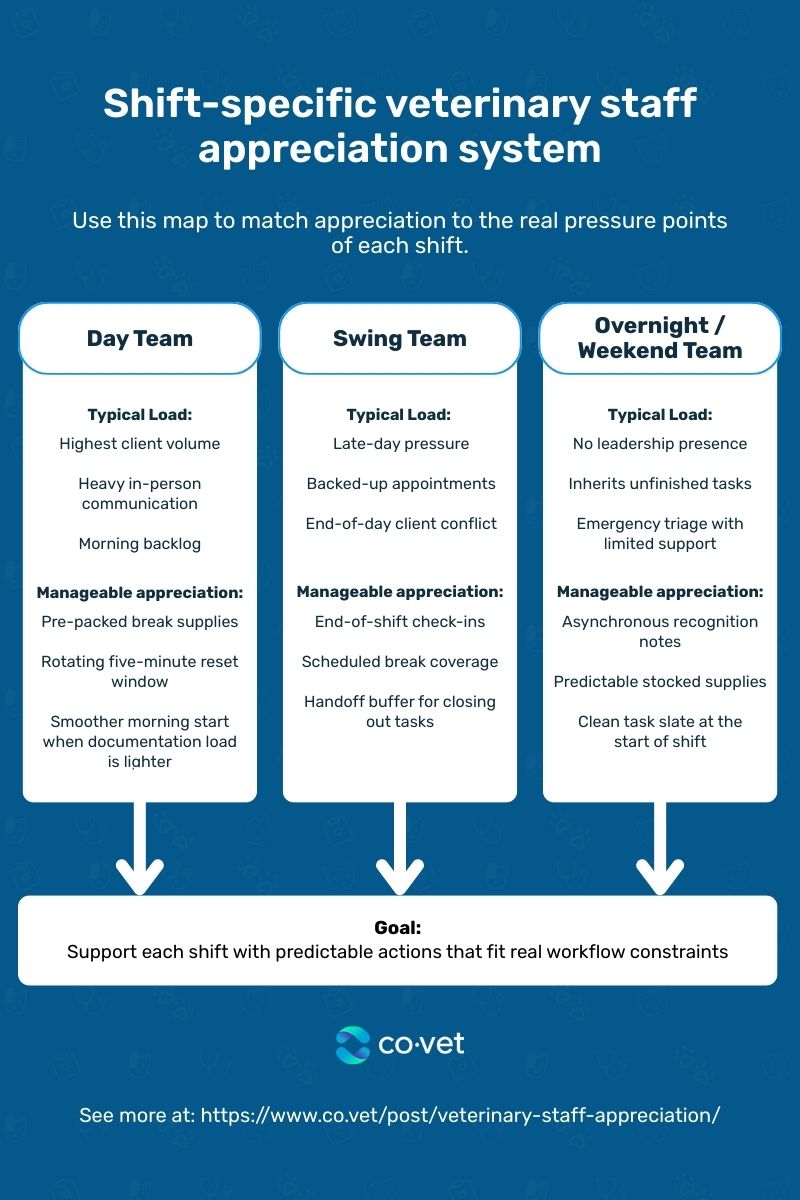
Day teams carry the highest client volume and handle most in-person interactions.
Swing teams absorb late-day pressure, including backed-up appointments and end-of-day client conflict.
Overnight and weekend teams often work with no leadership presence and inherit unfinished tasks from earlier shifts.
When appreciation only reaches the team leaders see most often, the rest of the staff notices. This is usually when resentment begins to surface.
A fast way to improve fairness is to map where each shift feels the most strain, then assign small, predictable touchpoints that match those patterns. This can be as simple as rotating stocked break supplies, adding end-of-shift check-ins, or leaving short asynchronous notes when you cannot overlap in person. Below is a simple visual to help teams see how this system fits together.
3. Use Technology to Reduce Daily Friction for Veterinary Staff
Burnout in veterinary medicine rarely comes from a single source. Emotional load, caseload pressure, client conflict, and compassion fatigue all contribute—and addressing these deeper concerns often benefits from professional support through resources like NOMV or MentorVet. Administrative work is only one part of the picture, yet it consistently shows up as a meaningful strain that clinics can address operationally. The veterinary burnout statistics make clear how much administrative load weighs on teams.
30–40% of DVMs experience burnout (Merck Veterinary Wellbeing Study).
64% of veterinarians report their administrative workload has doubled in the past year (Federation of Veterinarians of Europe).
Over half of this work is unpaid, which adds financial stress on top of time pressure (same source).
Veterinarians spend 10+ hours per week on documentation alone (same source).
These numbers reflect what many teams already feel day to day: administrative load makes everything else heavier. Reducing administrative strain won't address burnout on its own—emotional load, caseload pressure, and systemic factors all require separate attention—but it does lighten one meaningful source of daily pressure.
A practical approach is to identify two or three tasks that consistently slow your team down. In most clinics, these include:
SOAP notes
Callback messages
Repeated information handoffs
Once you know where the bottlenecks are, you can decide what to streamline or automate. Tools that support structured note capture, shared updates, or real-time documentation usually help lighten this pressure. Many clinics using CoVet describe the benefit in simple terms: they finally have enough space between cases to take a breath, reset, and keep the day moving.
Give your staff the time they keep losing to repetitive admin work. CoVet lightens documentation load across shifts so teams have more time between cases.
Next, we’ll look at how peer recognition builds on this improved baseline and helps support a healthier team culture.
4. Install a Peer-Recognition Engine That Works Without Management Oversight
Peer recognition works because staff understand each other’s workload in a way leadership often can’t. They see the small moments: the tech who guides a nervous client through a hard visit, the CSR who handles a frustrated caller with patience, the assistant who quietly keeps the day moving. A system helps capture these moments without relying on anyone “remembering” to do it. The most durable employee recognition programs run on a simple system rather than on anyone remembering to act.
A simple peer-recognition engine can be built around three components:
5. A Single, Simple Method For Capturing Recognition
Create one clinic-wide way to collect kudos that takes under a minute to use.
Examples include:
Small “kudos cards” at each workstation
A short digital form with three fields: name, moment, shift
The key is that it must be fast and predictable.
6. One Clear Place To Submit Recognition
Choose a single drop point so no one has to guess where kudos go.
Options include:
A labeled box in the break room
A shared digital folder for online submissions
Consistency makes the system feel reliable.
7. A Designated Kudos Champion To Keep The Engine Running
This role keeps the system alive without burdening the whole team.
Their responsibilities include:
Reminding staff to submit kudos during huddles
Asking team members to share one moment from the week
Writing down kudos on behalf of others when time is tight
Gathering and summarizing submissions for distribution
Ensuring every role gets visibility over time
This works especially well in busy clinics because it takes the cognitive load off the entire team.
8. A Recurring And Predictable Kudos Cadence
Choose one rhythm and maintain it consistently:
Weekly shoutouts posted in the break room
Biweekly highlights shared during morning huddles
Monthly shift-specific recognition printed near the schedule
When the cadence stays stable, participation grows naturally.
Client feedback can feed into this engine too. Many staff keep meaningful notes for years. One clinician shared: “I have a box full of letters… I look at them when I question why I keep going.”
Including one or two client notes each cycle reminds the team that their work resonates beyond the clinic walls.
A system like this doesn’t need to be complicated. It only needs to be predictable, low effort, and rotated across roles so everyone feels seen.
Next, we’ll move into job-specific appreciation so your support aligns with the real stressors in each role.
9. Create Job-Specific Appreciation Plans for Every Veterinary Role
Recognition lands harder when it reflects each role, and our vet tech tips go deeper on what technicians need day to day.
Appreciation resonates more when it reflects the actual pressure points of each role. This table gives managers a simple way to match support to the work each team member handles every day.
Role | Typical strain | Support that helps (manageable + realistic) |
|---|---|---|
Veterinary technicians | Complex treatments, client conflict, euthanasia support, emotional load | Protected procedure blocks, dependable access to key equipment, short debriefs after tough cases, recognition for guiding clients through difficult moments |
CSRs | High phone volume, scheduling stress, absorbing early client frustration | Rotation off phones during peak hours, clear scripts for difficult conversations, recognition for de-escalation, inclusion in clinical updates |
Assistants | Physical labor, room resets, animal handling, being pulled in many directions | Consistent training access, acknowledgment for maintaining flow, small autonomy moments in their workspace (e.g., reset preferences) |
Kennel staff / animal care attendants | Early/late hours, cleaning tasks, caring for hospitalized pets with low visibility | Scheduled leadership check-ins, appreciation for patient comfort work, predictable availability of cleaning and care supplies |
DVMs | Medical decision-making, client expectations, emotional fatigue, complex case load | Occasional relief with callbacks, streamlined team communication, acknowledgment for navigating challenging medical or financial discussions |
10. Replace Token Gestures With Meaningful Operational Support
Teams often enjoy small gifts, but what reliably improves morale is when the day becomes easier to manage. These ideas fit the real constraints of veterinary work and don’t require major restructuring:
Build rotating micro-breaks into the day so no one is consistently skipped.
Create a quick “cover window” so someone can step away for five minutes without worry.
Pre-stock exam rooms at the start of each shift to prevent repeated supply runs.
Batch discharge packets or go-home instructions earlier in the day.
Standardize where high-use supplies live so staff aren’t searching during busy periods.
Assign one team member per day as a runner during predictable pressure periods.
Let a staff member leave 10–20 minutes early when the schedule allows, or start slightly later after a difficult shift.
Offer short reset breaks after euthanasias or emotionally heavy cases.
Add brief blocks of phone coverage during mid-morning spikes to relieve CSRs.
Provide small boosts of support during discharges or last-hour appointments.
Use a weekly “who kept us moving” note to highlight behind-the-scenes work.
Include CSRs, kennel staff, and assistants in case follow-ups so they can see the impact of their work.
Invest in technology to reduce administrative pressure—many clinics use tools like CoVet to streamline documentation across the team so staff can redirect their energy to patients and each other rather than repetitive paperwork.
These small operational shifts tend to land more deeply than symbolic gestures because they directly improve how the day feels.
11. Make Professional Development a Visible Part of Staff Appreciation
Growth is one of the clearest ways to show people they matter long-term. Staff often interpret training access, CE support, and mentorship as signs that leadership sees potential in them, not just their current output. Even small steps make an impact when they’re predictable and visible.
Practical ways to offer growth-oriented appreciation include:
Setting aside a small monthly CE budget and rotating access fairly across roles
Giving staff time to shadow procedures or skills they want to learn
Offering short, structured mentorship moments during slower parts of the day
Sharing internal opportunities first so the team feels prioritized
These gestures work because they reinforce trust and investment, not hierarchy. When development support is part of your clinic’s regular rhythm, people feel valued in a way that lasts longer than any single gift or event.
Next, we’ll move into how structured client praise can amplify recognition inside the clinic.
12. Surface and Share Client Praise as Structured Veterinary Staff Recognition
Client feedback hits differently because it validates the work from the outside. When you capture that praise consistently, it gives your team something solid to hold onto during harder weeks. The challenge is that most appreciative moments never get documented unless someone explicitly asks for them.
A simple, predictable system can help:
Add a small line to post-visit texts or emails: “If a team member made your visit easier today, feel free to mention their name. We make sure the whole team sees your note.”
Give CSRs a quick, optional prompt for discharge conversations: “If anyone stood out during your visit, you can leave a note or mention them in your review. It really means a lot to the team.”
Maintain a shared log (digital or a small binder) where client comments are dropped throughout the week.
Highlight one or two mentions during huddles or in a weekly update so everyone—not just the person named—feels the lift.
These small prompts make it easier for clients to pinpoint staff by name, and they produce the kind of feedback teams rely on during heavy seasons. Many staff save these notes for years because they reconnect the work to its purpose.
Next, we’ll move into how to turn all of this into a durable operating system your clinic can maintain long term.
Related post: Veterinary Staff Meeting Ideas That Won’t Burn Out Your Team
13. Turn Veterinary Staff Appreciation Into a Durable Operating System
Appreciation lasts when it becomes part of how the clinic runs, not an extra task leaders try to squeeze in during calm weeks. Consistency matters more than scale. A small action you can sustain all year will always outperform a big effort that fades when caseload rises. Many clinics find that pairing appreciation with broader workflow improvements creates the strongest foundation. If you want to explore how to stabilize your operations more broadly, you can review guidance on veterinary efficiency.
A durable appreciation system can be built with a few simple elements:
Set predictable cadences
Daily micro-breaks, weekly kudos highlights, monthly role spotlights, and quarterly check-ins keep the rhythm steady.
Assign clear ownership
A kudos champion, a break-rotation lead, or a shift-equity check person helps maintain the system without adding pressure to leadership.
Document the basics
A short one-page guide—who handles what, when recognition happens, how client praise is collected—preserves consistency during staff changes.
Protect the system during busy seasons
Even in hectic weeks, keep the smallest version running. One kudos per week or a single client spotlight still signals stability.
When appreciation is built into everyday operations, it holds up under real clinic conditions. This steadiness helps teams feel acknowledged and supported even during the toughest weeks.
Show appreciation in a way your team can feel immediately. CoVet reduces documentation time so clinics can focus on people, not paperwork.
How to turn veterinary staff appreciation into lasting practice culture
Appreciation in veterinary medicine works best when it’s tied to the realities of the job. The pace, the interruptions, and the uneven pressures across shifts all shape how supported a team feels. When recognition focuses on reducing operational friction—through small workflow adjustments, predictable rhythms, and consistent acknowledgment—it becomes something staff can rely on, not just hope for.
The practices that sustain appreciation over time treat it as part of everyday operations. That approach helps teams feel valued in a way that lasts beyond any single gesture or event.
Frequently asked questions about veterinary staff appreciation
What is veterinary staff appreciation and why does it matter in a clinic setting?
Veterinary staff appreciation is the practice of recognizing the effort, emotional labor, and clinical skill that teams bring to daily operations. It matters because acknowledgment helps stabilize morale, strengthens trust, and supports a healthier working environment for every role on the team.
What are effective veterinary staff appreciation ideas clinics can implement quickly?
Fast, low-friction ideas include rotating micro-breaks, a weekly kudos highlight, role-specific recognition, client praise prompts, and small task relief during heavy caseloads. These approaches fit into real clinic workflows and require minimal setup.
How can veterinary clinics build a consistent veterinary staff appreciation program?
Clinics can build consistency by choosing a predictable cadence, assigning ownership (like a kudos champion), documenting simple procedures for recognition, and protecting these routines even during busy weeks. Predictability makes appreciation dependable.
How do shift schedules affect veterinary staff appreciation and fairness?
Shift schedules affect appreciation when certain teams—like swing, overnight, or weekend shifts—receive fewer touchpoints or less visibility. A shift-specific appreciation plan helps ensure fairness by matching support to each team’s workload.
What tools or technology can help streamline veterinary staff appreciation efforts?
Technology that reduces administrative load or automates routine communication helps free time for recognition. Shared digital kudos forms, message logs, or documentation tools that lighten repetitive tasks make it easier to maintain appreciation systems.
How can practice managers show appreciation to veterinary technicians specifically?
Technicians often value practical support like protected procedure blocks, quick debriefs after emotional cases, reliable access to equipment, and acknowledgment of their role in client education. Small workflow adjustments often resonate more than gifts.
What are examples of meaningful veterinary staff appreciation gestures beyond gifts?
Practical gestures include role visibility, short reset breaks, predictable resource availability, call coverage during high-pressure moments, and clear recognition of behind-the-scenes work. These actions improve the team’s day directly.
How can client feedback play a role in veterinary staff appreciation?
Client feedback becomes a valuable recognition source when clinics collect it intentionally. Simple prompts in post-visit messages or discharge conversations help clients name staff members directly, and weekly sharing helps the whole team feel supported.
How can veterinary practices support staff after emotionally difficult cases?
Operational support can include brief debrief conversations, short reset breaks, optional follow-ups to check in, and predictable space for staff to step away when needed. These actions acknowledge emotional strain while keeping workflows steady. For deeper support around compassion fatigue or moral distress, staff can access professional resources through organizations like NOMV or MentorVet.
How do clinics create a long-term veterinary staff appreciation strategy that lasts?
Sustainable strategies rely on small, repeatable actions. Clear ownership, simple documentation, and consistent cadences help clinics maintain appreciation through busy seasons and staffing changes.
About the Author
)
)
)