
According to the AVMA, nearly 40% of veterinary professionals already use AI tools in practice. For most practice managers, the question is no longer whether to adopt an AI scribe. It is which one fits your clinic's workflow.
CoVet and ScribbleVet both generate SOAP notes from recorded appointments, integrate with major PIMS systems, and offer a 14-day free trial. Where they differ is in how documentation works at the team level, how much editing remains after the note comes back, and how well each tool scales across multiple DVMs and locations.
CoVet vs. ScribbleVet: Quick comparison
Tech changes fast. The information below is accurate as of February 2026 but should be verified directly with each vendor before making a purchasing decision.
CoVet | ScribbleVet | |
Primary approach | AI-powered structured documentation platform | AI-powered scribe and SOAP note generator |
SOAP note generation | Automated, structured output generated in ~30 seconds | Automated, structured output generated within minutes of appointment |
Template customization | 95+ customizable templates, AI-assisted template builder | Self-serve customization: add sections, adjust formatting, set style preferences |
Multi-patient support | Yes; auto-creates separate records for each patient from a single recording | |
Personalization tools | Personal dictionary, custom abbreviations, custom snippets, and per-template instructions | Template customization via self-serve editor or email request |
Mobile support | Yes; iOS, Android, and web | Yes; iOS, Android, and web |
Client communication | Auto-generated client summaries, discharge instructions, branded PDFs | Client-friendly recap email and Care Cards (discharge infographics) |
Phone/call documentation | Yes; built-in calling with shared clinic number, auto-transcribed into patient record | Yes; Direct Dial feature using clinic's verified number |
PIMS integrations | 11 named integrations including Avimark, Cornerstone, Impromed, Instinct, Vetspire, and more; Chrome extension for web-based PIMS | 7 named integrations including ezyVet, Pulse, Vetspire, Instinct, Shepherd, DaySmart, Rhapsody; Chrome Browser Companion |
Data security | SOC 2 Type II, HIPAA, GDPR, PIPEDA, CCPA | |
Pricing | Free Support plan available; Essentials from US$63/month; 14-day free trial, no credit card required | Per-DVM pricing; support staff seats included free on Practice Plan; 14-day free trial, no credit card required. Contact ScribbleVet for current rates. |
Best for | Team-based, structured documentation workflows across multi-location practices | Individual clinicians and smaller practices looking for a straightforward dictation-to-SOAP workflow |
CoVet: Key features, pros, and limitations
CoVet describes itself as an AI copilot for veterinary documentation, not just a scribe. The distinction is in what happens after the recording ends. Rather than returning a raw transcript, CoVet generates a structured, reviewable SOAP note in around 30 seconds, ready for clinician approval and PIMS transfer. For a practice manager evaluating AI tools in veterinary practice across a multi-DVM or multi-location team, that structured output is the core of the value proposition.
Key features | Automated SOAP generation, 95+ customizable templates, AI template builder (CoCo), multi-patient recording, visual dental charting, client summaries and branded PDFs, built-in phone documentation, 11 PIMS integrations, clinical decision support via LifeLearn Sofie AI |
Pricing | Free Support plan (upload only); Essentials from US$63/month billed annually; Unlimited from US$136/month billed annually; Enterprise pricing available. 14-day free trial, no credit card required. |
Pros | Team-based workflow; shared templates across locations; broad PIMS compatibility including legacy systems; Enterprise Dashboard for multi-location oversight |
Limitations | Initial setup and template configuration requires deliberate time investment; all notes require clinician review before entering the patient record |
Best for | Multi-DVM and multi-location practices where documentation is a shared team responsibility |
Key features
CoVet's workflow runs capture, generate, export. Input options include live recording, typed notes, phone call transcription, audio file uploads, and PDF uploads including photos of handwritten notes. From a single multi-pet recording, CoVet can auto-generate separate records for each animal, which matters in shelter, farm call, or multi-pet household appointments.
The creating effective vet SOAP notes process is handled before the note ever reaches your PIMS, not after. The platform also generates client-facing summaries, branded discharge PDFs, and automatic task and billing item detection from consultation recordings. On the clinical side, Consult CoVet (powered by LifeLearn Sofie AI) surfaces differentials and treatment considerations without leaving the documentation workflow.
Pros
CoVet is built for documentation to be a team function. Techs, CSRs, and managers can be added as Support-tier users at no extra cost, which matters when you're thinking about who owns the copy-paste step into your PIMS.
The role of veterinary management software in a multi-location practice increasingly involves coordination across roles, not just record-keeping, and CoVet's shared templates and Enterprise Dashboard reflect that. PIMS compatibility is among the broadest in the category, covering 11 named systems including Avimark, Cornerstone, and Impromed, which means practices still on legacy platforms aren't excluded. The Chrome extension adds a fallback for any web-based system not on the named list.
There is also a strong human-in-the-loop ability programmed in, so you can feel safe nothing will be hallucinated or go out incorrectly without human review.
Limitations
CoVet's configuration depth is genuinely useful once it's set up, but it does mean more upfront effort than plug-and-play tools. Practices with limited onboarding time or low tech adoption among clinical staff may find the initial learning curve slower than expected.
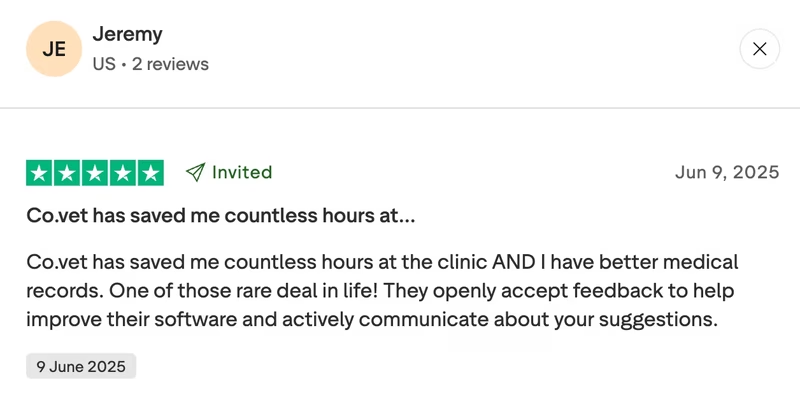
ScribbleVet: Key features, pros, and limitations
ScribbleVet is a veterinary dictation software built around a straightforward premise: record your appointment, get a formatted SOAP note back within minutes, with minimal editing required. Its ambient filtering means clinicians can speak naturally during exams without worrying about small talk, filler words, or having to spell out medication names.
Since its acquisition by Instinct Science in January 2026, ScribbleVet is now part of a broader ecosystem that includes Instinct EMR, Plumb's, and Clinician's Brief.
Key features | Ambient-filtered SOAP generation, visual canine and feline dental charting, 1-click PIMS transfer, client recap email and Care Cards, Direct Dial phone documentation, LifeLearn Sofie AI clinical decision support, Plumb's drug monograph integration, record summarizer |
Pricing | Per-DVM pricing; support staff seats included free on the Practice Plan; 14-day free trial, no credit card required. Contact ScribbleVet for current rates. |
Pros | Fast to set up and easy to adopt; individual clinician control over note structure; free staff seats on Practice Plan; practice-owned data model |
Limitations | PIMS integration list is smaller than some competitors; pricing not publicly listed; note structuring can still require manual effort depending on template setup |
Best for | Individual clinicians and smaller practices looking for a low-friction dictation-to-SOAP workflow; practices already using Instinct EMR |
Key features
ScribbleVet records appointments and converts natural speech into formatted SOAP notes without requiring clinicians to speak punctuation, spell medication names, or filter their own speech. Off-topic conversation is automatically removed.
The platform includes visual dental charting for both canine and feline patients, mapping COHAT findings directly to individual teeth. PIMS transfer is handled via a Chrome Browser Companion with 1-click mapping to supported systems including ezyVet, Pulse, Vetspire, Instinct, Shepherd, DaySmart, and Rhapsody. Client-facing outputs include an auto-generated recap email and Care Cards, which are branded discharge infographics pet owners can take home.
Pros
ScribbleVet is fast to get started and designed to fit into an existing workflow without significant reconfiguration. For individual clinicians who want control over their own note structure, the self-serve template editor lets them adjust sections, formatting, and output style without needing team-wide changes. The Practice Plan's per-DVM pricing model includes free seats for all support staff, which means techs and practice managers can participate in the documentation workflow without adding to the subscription cost. On the Practice Plan, all data is owned by the clinic, not individual user accounts, which addresses a common concern when staff turnover happens.
Limitations
ScribbleVet's PIMS integration list covers 7 named systems, which may be a consideration for practices running older or less common platforms. Pricing is not publicly listed, which makes it harder to compare costs at the evaluation stage without a direct conversation with the vendor. Template customization, while available, has historically involved emailing requests to the ScribbleVet team for more complex changes, though a self-serve editor launched in early 2025 has expanded what clinicians can adjust independently. As with all tools in this category, clinician review of every generated note remains a required step before records enter the PIMS.
Key differences between CoVet vs. ScribbleVet
Both tools solve the same core problem: documentation takes too long and cuts into patient care time. Where they differ is in how they approach that problem and who they're built for. CoVet centralizes documentation as a team function.
ScribbleVet gives individual clinicians a fast, flexible overlay on their existing workflow. Neither approach is wrong. The right fit depends on whether your practice needs a shared documentation environment or a per-clinician tool. For a deeper look at how these approaches compare to traditional methods, see our guide on dictation versus transcription in vet practice.
How much structuring work remains after capture
The most important question to ask during any scribe tool trial is not how fast the note comes back. It's how much editing the clinician still has to do before that note is ready to enter the PIMS. Both tools require clinician review and approval. The difference is where the structuring effort sits.
CoVet | ScribbleVet | |
Output format | Fully structured SOAP note generated before clinician review | Formatted SOAP note generated from ambient recording |
Structuring approach | AI structures the note before it reaches the clinician | AI converts speech to formatted output; clinician may adjust structure depending on template setup |
Template setup | CoCo AI template builder; 95+ templates; shareable across team via unique links | Self-serve editor for sections, formatting, and style; more complex changes may require support team involvement |
Editing typically required | Light review and approval | Light to moderate depending on template configuration and recording quality |
Clinician sign-off required | Yes | Yes |
Team and multi-patient workflows
Documentation in a multi-DVM practice is rarely a solo task. Techs start recordings. Managers review completion. CSRs handle transfers. A tool optimized only for the clinician at the mic can create coordination gaps that add time back into the workflow elsewhere.
This is less about clinic size and more about whether documentation is treated as a shared responsibility across roles. For more on how support staff fit into this picture, see our guide on vet tech tips.
CoVet | ScribbleVet | |
Team access model | Free Support-tier accounts for non-DVM staff at all plan levels | Free staff seats for techs, managers, and front desk on Practice Plan |
Multi-patient recording | Auto-generates separate records for each animal from a single recording | |
Shared templates | Templates customizable per clinician; not designed for team-wide sharing | |
Multi-location oversight | Enterprise Dashboard for adoption monitoring across locations | Admin dashboard available on Practice Plan; no multi-location specific tooling confirmed |
Data ownership | Clinic-level on Enterprise plan | Practice-owned on Practice Plan; individual user accounts on Essential plan |
Role-based workflow | Techs, DVMs, and managers each have defined roles in the documentation process |
Data handling, privacy, and compliance
For a hospital manager, data security is often a deal-breaker question, not a nice-to-have. Both tools have achieved SOC 2 Type 2 certification. Beyond that, the specifics differ in ways that matter depending on your clinic's location, ownership structure, and patient consent workflow.
It is worth noting that veterinary medicine is not covered by HIPAA. Recording consent in the exam room is governed by state wiretapping laws, which vary significantly. California, Florida, and Pennsylvania are among the states that require all-party consent for recordings. Consult your legal team before rolling out any ambient recording tool.
CoVet | ScribbleVet | |
Security certification | ||
Data hosting | Google Cloud Platform | Not publicly specified |
Data ownership | Clinic-level on Enterprise; per-user on lower tiers | |
HIPAA applicability | Veterinary medicine is not covered by HIPAA. CoVet lists HIPAA compliance as part of its security framework. | Not applicable to veterinary medicine; not listed |
Model training on your data | Trust portal available at app.mycroft.io/trust/covet | Privacy policy available; practice data handling detailed on Practice Plan |
What to look for in an AI veterinary scribe
Choosing an AI scribe affects every person on your team who touches a patient record. Studies in human medicine cited by the VetPartners Utilization Guide suggest ambient scribes can reduce note time by around 20% and after-hours work by roughly 30 minutes per day, though veterinary-specific data remains limited. Three variables determine whether your practice sees those kinds of gains:
How much of the documentation process the tool actually covers
Whether it works for your whole team or just the clinician holding the mic
How much editing is still required after the note comes back
For a broader overview of how to evaluate tools in this category, see our guide on the role of veterinary management software.
Tools that save time before, during, and after an appointment
Total documentation time includes capture, structuring, review, and PIMS transfer. A tool that produces fast but unstructured output can cost more total time than it saves once you factor in the editing required before the note is ready to file. For a detailed comparison of approaches, see our guide on dictation versus transcription in vet practice.
Stage | What to look for | CoVet | ScribbleVet |
Before the appointment | Can the tool pull in patient history, flag recurring conditions, or summarize prior records? | History-only button summarizes patient histories instantly | Record summarizer condenses prior records into chronological or problem-focused summaries |
During the appointment | Does capture work across multiple patients, multiple staff, and varied input types? | Multi-patient recording; live recording, typed notes, phone, audio files, PDF uploads all supported | Ambient recording with automatic filtering; multi-patient supported with clear labeling |
After the appointment | How structured is the output? How much editing remains before PIMS transfer? | Structured SOAP generated in ~30 seconds; minimal editing typically required | Formatted SOAP generated within minutes; light to moderate editing depending on template setup |
Client communication | Does the tool generate client-facing outputs without additional steps? | Auto-generates client summaries, discharge instructions, and branded PDFs | Auto-generates client recap email and Care Cards |
Phone documentation | Are phone calls captured and transcribed into the patient record automatically? | Built-in phone system; auto-transcribed into patient record | Direct Dial using clinic's verified number; produces clinical note and client summary |
Multi-team and multi-pet support
DVMs are not the only people who touch patient records. Techs start recordings. Practice managers review completion rates. CSRs handle PIMS transfers. A tool optimized only for the clinician at the mic creates coordination gaps that add time back into the workflow elsewhere. Appreciating your veterinary staff means giving the whole team tools that work for their role. For more on structuring this across your team, see our guide on veterinary efficiency.
Key questions to ask during evaluation:
Who owns the copy-paste step into the PIMS, and does the tool support that person directly?
What happens to records when a staff member leaves?
Can templates be standardized across locations without manual redistribution?
Does the tool give managers visibility into documentation completion rates?
Dedication to accuracy and customization
Transcription accuracy and output customization are related but distinct. A tool can convert speech to text accurately and still produce records that need heavy editing if the template structure does not match your PIMS or your clinic's documentation standards. Both matter independently. For more on building documentation that holds up clinically and legally, see our guide on creating effective vet SOAP notes.
What to pressure-test during your trial:
Does the output match your existing PIMS template without significant reformatting?
Can individual clinicians adjust terminology, abbreviations, and section structure without involving support?
Does the tool understand veterinary-specific language out of the box, or does it require training?
Is clinical decision support available within the documentation workflow, or does it require switching tools?
Get started with the right AI documentation tool for your clinic
The right tool depends on how documentation currently works at your practice and where the biggest friction points are. Use these questions to narrow down your decision before starting a trial.
Choose CoVet if:
You manage documentation across multiple DVMs or multiple locations
You need templates and workflows to be consistent across your whole team
Your practice runs on a legacy PIMS like Avimark, Cornerstone, or Impromed
You want non-DVM staff included in the documentation workflow at no extra cost at every plan level
You want a single platform that handles SOAP notes, client communication, phone documentation, and clinical decision support without switching tools
Choose ScribbleVet if:
You are a solo DVM or a small practice looking for a fast, low-friction setup
Individual clinicians want control over their own note structure without team-wide changes
Your practice already runs on Instinct EMR and deeper integration is a priority
You want to start with one or two DVMs and expand gradually
Worth checking for both:
Run the full 14-day free trial across your typical caseload, not just a few test appointments
Involve your techs and support staff from day one, not just the DVMs
Compare total documentation time per appointment, including editing and PIMS transfer, not just how fast the note comes back
Verify current pricing and integration compatibility directly with each vendor before committing
For a detailed breakdown of what scribe tools typically cost and what to watch for, see our guide on understanding scribe pricing.
Frequently asked questions about CoVet vs. ScribbleVet
What is the difference between CoVet and ScribbleVet for veterinary documentation?
CoVet and ScribbleVet take different approaches to the same problem. CoVet generates a fully structured SOAP note before it reaches the clinician for review, and is built around team-based workflows, shared templates, and multi-location coordination. ScribbleVet converts ambient speech into a formatted note that the clinician reviews and adjusts, and is designed primarily around individual clinician control. For practices deciding between a shared documentation environment and a per-clinician overlay tool, that is the core distinction. For more on how these approaches differ at the input level, see our guide on dictation versus transcription in vet practice.
Is CoVet a veterinary AI scribe or a dictation tool?
CoVet is an AI scribe, not a dictation tool. Dictation tools convert speech to text and return the transcript for the clinician to structure. CoVet generates a structured SOAP note directly from the recording, including sections, formatting, and clinical detail, ready for review and PIMS transfer. It also supports input beyond live recording, including typed notes, phone calls, audio file uploads, and PDF uploads. For more on how automated SOAP note generation works in practice, see our guide on creating effective vet SOAP notes.
Is ScribbleVet a good fit for veterinary dictation workflows?
ScribbleVet works well for clinicians who prefer to control their own note structure and want a low-friction tool that fits into their existing workflow without significant reconfiguration. Its ambient filtering removes off-topic conversation automatically, so clinicians can speak naturally during appointments without adapting their consultation style. It tends to suit individual DVMs and smaller practices more than multi-DVM teams that need standardized documentation across locations.
How do CoVet and ScribbleVet handle SOAP notes?
Both tools generate formatted SOAP notes from recorded appointments and both require clinician review and approval before notes enter the PIMS. The difference is in the structuring step. CoVet produces a fully structured output before review, meaning the clinician is approving and signing off rather than reorganizing. ScribbleVet produces a formatted note that may require light to moderate adjustment depending on template configuration and recording quality. Neither tool eliminates the clinician review step, and neither should. For more on SOAP note structure and what complete documentation looks like, see our guide on creating effective vet SOAP notes.
Are CoVet and ScribbleVet compliant for veterinary records?
Both tools have achieved SOC 2 Type 2 certification. It is worth noting that veterinary medicine is not covered by HIPAA, as veterinarians do not qualify as HIPAA covered entities under the Department of Health and Human Services standards. Data security obligations for veterinary practices come from state-level privacy laws, which vary by location. CoVet also holds GDPR, PIPEDA, and CCPA certifications, which may be relevant for practices with international clients or those operating across multiple jurisdictions. Consult your legal team regarding your specific state's requirements before rolling out any ambient recording tool.
About the Author
)
)
)