
Your practice's sale price is determined by profitability, not revenue. Practices with identical gross revenue can have vastly different values—sometimes a 6-figure gap—based on adjusted net profit and operational efficiency. This guide shows you how to build value in the 2-3 years before you sell.
You've built a strong practice. Full schedule, loyal clients, solid reputation. But when it comes time to sell, none of that guarantees the price you're expecting.
This article breaks down what actually drives veterinary practice valuation: adjusted net profit calculations, expense management benchmarks, documentation workflows that prove operational consistency, and the modernization improvements buyers require. You'll learn which operational levers raise your sale price and how to position your practice for maximum value—whether you're selling to a private veterinarian or corporate buyer.
Your practice's profitability determines its value. Discover how CoVet helps reduce administrative costs while improving documentation consistency.
The profitability gap that determines your veterinary practice sale price
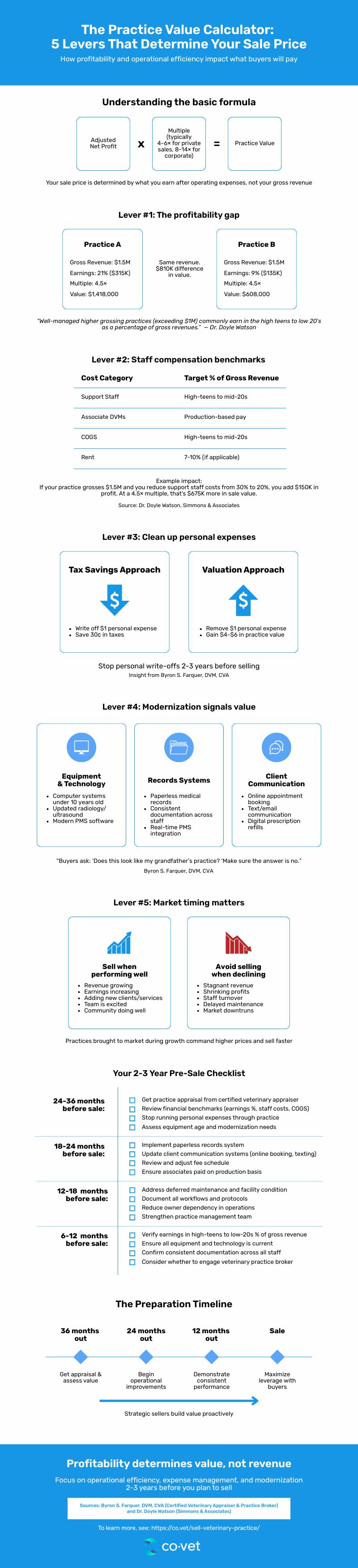
Veterinary practices are typically valued using what's called a multiple. A multiple is a number that gets multiplied by your practice's adjusted net profit to determine its worth. Understanding this calculation is critical because it shows why profitability matters more than revenue.
Byron S. Farquer, DVM, CVA, is a Certified Veterinary Appraiser and Veterinary Practice Broker. We interviewed him for this article, and he shared insights from his work consulting with practice owners preparing for sale. One common surprise he sees: owners who think they're profitable often aren't—at least not from a valuation standpoint.
What is adjusted net profit?
Adjusted net profit is what remains after all reasonable operating expenses a practice's earnings are what remains after all true and reasonable operating expenses—not capital expenses—have been paid, including a fair market salary for the managing veterinarian. This is your return on investment as an owner—separate from your compensation as a practicing veterinarian.
Byron shared a real example from his appraisal work: A practice generating $1.5 million in revenue with $300,000 showing on the tax return. The owner felt profitable and was drawing a good portion of that $300,000. But Byron dug deeper. The practice was structured as a sole proprietorship, and the owner didn't pay himself rent for the building he owned. Based on market rates and building size, that rent should have been about $80,000 per year. Based on his production, the owner's expected doctor compensation should have been just under $240,000 per year.
Here's the math: $300,000 net income - $80,000 in rent - $240,000 in doctor compensation = -$20,000. The owner thought he had significant profit. In reality, the practice was losing money from a valuation perspective.
This pattern shows up repeatedly in Byron's consulting work. Practices look profitable on paper, but once you account for what the owner should be paying themselves as a doctor and reasonable operating expenses, the adjusted net profit—the number that determines sale value—is much lower than expected.
The most common problems are associate and support staff compensation that exceeds industry benchmarks, cost of goods sold (COGS) that climbs too high, and rent that takes up more than 7-10% of revenue. Improving veterinary efficiency in areas like documentation and workflow can help address some of these operational costs without sacrificing quality of care.
Why earnings matter more than revenue in veterinary practice valuation
Understanding the difference between what you earn as a veterinarian and what you earn as an owner is essential when preparing to sell.
In his analysis, Watson explains that practice owners receive income from two distinct sources: compensation as a working veterinarian (which should reflect fair market rates, just as an associate is paid) and return on their ownership investment—the profit or earnings that determine practice value.
Watson's research is clear: earnings are what "almost entirely create" a practice's goodwill value. This is why Practice A from our earlier example—with $315,000 in earnings—appraised at $1.4 million while Practice B with only $135,000 in earnings was worth just $608,000, despite identical gross revenues.
Buyers need your practice's earnings to fund their loan payments and provide a livable income. If the earnings aren't there, the practice isn't financeable at the price you're hoping for, regardless of how busy your schedule looks or how much revenue flows through your doors.
How EBITDA Multiples Work and Where Most Practices Fall Short
Key financial terms to know:
EBITDA: Earnings Before Interest, Taxes, Depreciation, and Amortization. In simpler terms, it's a measure of your practice's profitability that appraisers use to determine what your practice is worth.
Multiple:
The number that gets multiplied by your EBITDA (or adjusted net profit) to calculate your practice's sale value. For example, if your practice earns $200,000 and sells at a 5× multiple, it's worth $1,000,000.
COGS (Cost of Goods Sold):
The direct costs of products you use to treat patients—medications, vaccines, surgical supplies, prescription diets, and other medical inventory. This doesn't include staff salaries or rent.
According to Dr. Watson's research, fair market value transactions commonly see practices selling for 4 to 6 times earnings, though multiples vary with market conditions and deal specifics. Corporate buyers typically pay higher multiples—Watson notes figures ranging from 8 to 14 times adjusted profit in some transactions.
But higher multiples don't fix low earnings. Using Practice B's scenario from Watson's analysis: $135,000 in earnings × 5 multiple = $675,000. That's nowhere near the $1 million-plus that most sellers expect from a $1.5 million gross revenue practice.
The problems Watson identifies most often are "compensation to both support staff and associate veterinarians" and COGS, which "should be about the same range [as support staff: high-teens to mid-20s]." Rent exceeding 7-10% of real estate value also drags down profitability.
The timing matters. Watson states that better expense management is "one of the most powerful levers for a higher value." If you're planning to sell within two to three years, these expense ratios need attention now. Waiting until you're ready to list means leaving money on the table or watching buyers walk away when the numbers don't support their financing.
Cleaning up personal expenses before you list
Dr. Farquer recommends looking at your financials 2-3 years before you plan to sell, and one of the first tasks is cleaning up personal expenses that run through your practice. Every business owner does this to some degree—a cell phone bill here, vehicle expenses there. The tax savings feel worth it in the moment.
But Dr. Farquer breaks down the math differently when you're preparing for sale. If you write off a dollar of personal expenses, you save about 30 cents in taxes at a typical effective tax rate. That feels like a win. However, at common valuation multiples of 4 to 6 times, every sustained $1 of profit could translate into roughly $4 to $6 in practice value.
So you have two choices: keep writing off personal expenses and save 30 cents on every dollar, or stop doing that, lose the 30 cents in taxes, but gain $4 to $6 more in practice value (at typical multiples). The trade-off is worth it when you're within a few years of selling.
Dr. Farquer also recommends looking at your fee schedule during this preparation period. You might adjust fees once a year, maybe less frequently. But if you've only got two to three years left of ownership, now's the time to make sure your fees are current. You don't have another decade to collect revenue from the practice. You've got a limited window, so maximize that opportunity while you still own it.
Finally, look at your expense benchmarks. Do you know what your labor costs should be as a percentage of revenue? Do you know where your COGS should fall? Dr. Farquer suggests talking to your business consultant or veterinary appraiser to address key performance indicators now, not six months before listing when it's too late to show a pattern of improved profitability.
Owners should review these strategies with their accountant, tax advisor, or veterinary appraiser before making changes. The trade-offs between tax savings and valuation impact depend on individual circumstances.
Building a sale-ready veterinary practice through operational efficiency
If earnings determine your selling price, then cutting costs and increasing efficiency should be your focus in the years before you list. The question is where to start.
Simmons & Associates identifies several red flags that make practices harder to sell:
Outdated equipment or cramped facilities
Paper-based charting systems
Practices that can't run smoothly in the owner's absence
The guide emphasizes that "buyers are seeking stability from the team, as it is the backbone of a good practice." Buyers discount practices that depend on the owner's institutional knowledge. If you're the only one who knows which clients need special handling, which suppliers to use, or how to navigate your record-keeping system, that dependency becomes a liability.
Dr. Watson's operational framework identifies three areas that impact value: documentation workflows need to be consistent, staffing ratios should keep "support staff as a percent of gross revenues" in the "high-teens to mid-20's," and Watson recommends that compensation structures consider production-based pay for associates rather than flat salaries or hourly rates.
Modern veterinary practice management systems can help address these gaps. AI tools like CoVet's clinical copilot automate documentation and generate PMS-ready outputs—freeing up your team for client care while creating consistent processes that prove your practice runs on established protocols rather than owner memory.
Reducing Documentation Backlogs That Signal Owner Dependency
Documentation backlogs could signal concerns to buyers. When DVMs finish notes from memory hours after appointments or record quality varies across the team, it might suggest the practice depends on individual practitioners remembering details rather than capturing them systematically. Simmons & Associates notes that buyers scrutinize "whether the practice can operate profitably without the owner present, which requires modern systems and consistent protocols."
Some large-scale analyses suggest inefficient workflows can add several minutes per appointment compared to high-performing peers. These problems are common, but they're not normal. If your practice sees 20 appointments a day, that's 2.5 to 5 hours of lost productivity—time that could go toward revenue-generating activities or actually getting your team home on time.
The bonus: better client relationships
When your team isn't mentally tracking what they need to chart later, they can focus on the client and patient in front of them. That attention improves client relationships and builds loyalty—metrics buyers review when assessing practice stability and growth potential.
A veterinary AI scribe like CoVet can help your practice run more smoothly without you there. Here's how practices are using it:
Capture notes in real-time during exams so your DVMs aren't recreating conversations from memory
Maintain consistent medical record formatting across all team members, regardless of experience level
Sync directly to your PMS so records are complete before the client leaves
Pull up summaries of previous visits so anyone on your team can walk into an appointment prepared
Cut down on after-hours charting that drives up labor costs and contributes to veterinarian burnout
These systems create documented workflows that prove your practice operates on established protocols rather than institutional knowledge—the operational maturity appraisers look for during valuations.
Managing Support Staff and Associate Compensation for Higher Profit Margins
In his work consulting with veterinary practices, Dr. Watson identifies compensation as one of the most common areas where profit margins shrink. He notes that "the common problem areas seem to be in compensation to both support staff and associate veterinarians."
For associate DVMs, Watson recommends that practices consider production-based compensation rather than flat salaries or hourly rates. Many appraisers advise this approach to align incentives and protect margins, though compensation structures should reflect the practice's specific circumstances.
Here's an example to illustrate how staffing costs impact your sale value:
Practice Revenue | Support Staff Cost | Adjusted Net Profit | Multiple | Practice Value |
|---|---|---|---|---|
$1.5M | $300K (20%) | $300K | 4.5× | $1.35M |
$1.5M | $450K (30%) | $150K | 4.5× | $675K |
This is a simplified example for illustration purposes. Your actual valuation depends on multiple factors.
The difference between keeping support staff costs at 20% versus 30% of revenue translates to a $675,000 gap in practice value—using the same revenue and the same multiple.
AI-powered documentation and workflow tools can help address staffing efficiency. When administrative tasks like charting and PMS data entry are automated, practices can serve more patients with current staffing levels or redeploy team members to higher-value clinical work.
We've heard from practices using CoVet that they've been able to reduce documentation time significantly, which affects how efficiently the team operates overall. This operational efficiency could impact the labor cost ratios that influence your practice's profitability.
Managing veterinarian burnout through better workflows also helps with staff retention—another factor buyers evaluate.
When Modern Workflows Prove the Practice Runs Without You
Dr. Farquer's first recommendation when preparing a practice for sale: modernization. He asks owners one simple question: "Are buyers going to look at my practice like it's their grandfather's practice?"
Three modernization priorities:
1. Equipment and technology If your computer systems, radiology, or ultrasound equipment is a decade old, it might be time to consider upgrading—especially if you can spread the expense over a few years and gain some return on investment before selling.
2. Records systems Most younger buyers expect paperless practices. Your software should be the most updated version available, and you should be able to produce reports that buyers will request during due diligence.
3. Client communication Clients now expect online appointment booking, text/email responses, and the ability to purchase products or refill prescriptions online. Relying only on phone and in-person communication signals you're behind.
The first impression problem:
Dr. Farquer notes that facility condition matters more than you'd think. "Deferred maintenance"—things you should fix but haven't—creates a negative first impression. As he puts it: even a restaurant with exceptional food suffers if it's dirty and cluttered. The same applies to your practice.
AI-powered documentation tools like CoVet's clinical copilot help address these modernization concerns by automating documentation and generating PMS-ready outputs that prove your practice operates on established systems rather than owner memory.
Modern documentation systems can signal operational maturity to buyers. See how CoVet's AI copilot helps create consistent workflows across your team.
Timing your sale to maximize value and reduce transition risk
Dr. Farquer recommends getting a practice appraisal 18-24 months before you plan to sell. This gives you time to make operational changes and, if facilities or equipment need improvement, spread those costs over time so they don't all hit at once.
The timing risks are real. Simmons & Associates notes that "we've seen many owners delay selling only to face declining profits, staff turnover, market downturns, and more—only now they've missed their window to fix it." They add that "in most cases, the practice ends up being worth less when they finally decide to sell." Strategic sellers build value proactively rather than reacting to problems.
“You now have to stop for a moment, walk over the other side of the room and put your feet in the buyer's shoes. What practice do you want to buy? One that's stagnant, one that's shrinking, one that's just doing about the same thing, or one that's exploding and growing and going places and it's exciting and the staff's excited and the community's doing well." - Dr. Byron Farquer, DVM
Corporate Buyers vs Private Sales: Structure, Terms, and What to Expect
The structure of your deal depends heavily on who's buying your practice.
Private sales (Fair Market Value):
According to Dr. Watson's research, practices selling on the fair market typically gross $800K–$1.5M with 1-2 FTE DVMs. Buyers usually fund purchases through commercial financing, and sellers are often cashed out at closing. If the selling DVM owns the real estate, it typically sells with the practice. These tend to be "turn-key" transactions with minimal transition period.
Corporate sales (Corporate Investment Value):
Corporate buyers operate differently. Dr. Watson notes ideal corporate acquisition targets gross over $1.5M with at least 3 FTE DVMs in desirable suburban areas. Capital comes from private equity or family funds, and corporations typically don't purchase real estate. Sellers should expect employment agreements requiring 2-3+ years of continued work, with some proceeds paid later via earnouts, holdbacks, or retention bonuses. Deals may also include parent company stock or retained ownership in the practice.
Location: the factor you can't change but veterinary buyers care about most
Dr. Farquer's consulting work reveals that location has become the #1 factor affecting whether a practice sells. The criteria have gotten increasingly specific over time.
He explains: "Four decades ago vets typically looked at states, ie Arizona but not New Mexico, Nevada perhaps but not New York, etc... in their search. 20 years ago it became more regionalized within a state. Southern California not northern, or front range of Colorado not the western slope. Today its sometimes almost down to zip code. Buyers have gotten very particular about where they want to live."
You can't change your zip code, but understanding this helps set realistic expectations about your buyer pool and timeline.
After-debt income: why associates hesitate to buy
Dr. Farquer identifies after-debt income as the second major factor buyers evaluate—especially in high cost-of-living areas. After-debt income is what the buyer takes home after making their loan payment each month.
Thirty years ago, nearly every practice purchase would pay the buyer more than they earned as an associate. That's changed. Dr. Farquer notes: "In high demand areas some associates are earning $150,000 to $225,000 a year. Many solo veterinarian practices (1 DVM only) might not produce that much of after-debt income (amount left for the buyer after making the loan payment to buy it). If the associate has become accustomed to a lifestyle at $200,000 per year, they are checking to see if the practice they are considering purchasing can match that number or more."
This is why profitability matters so much. A practice with strong earnings supports higher after-debt income, making it attractive to well-compensated associates who might otherwise stay employed.
Assess your practice's operational efficiency and documentation workflows. See how CoVet's AI-powered clinical copilot could support your operational goals.
Build Value Now, Sell From Strength Later
Dr. Farquer's central insight from his appraisal work: profitability determines value, not revenue. As Dr. Watson states, better expense management is a primary driver of higher value.
Simmons & Associates warns that owners who delay often face "declining profits, staff turnover, market downturns" that erode value. The practices that command the best prices are the ones performing well when they hit the market.
Next steps:
Evaluate your current operations using the benchmarks Dr. Watson and Dr. Farquer outlined—are your earnings in the high teens to low 20s as a percentage of gross revenue? Identify documentation and workflow gaps that might signal owner dependency to buyers. Modern AI-powered tools like CoVet's clinical copilot can help demonstrate operational maturity through automated SOAP notes, PMS integration, and standardized workflows.
If you're thinking about selling within the next few years, build systematic efficiency now. The preparation you do 2-3 years before listing gives you leverage with buyers and maximizes your practice's value.
Frequently asked questions about selling a veterinary practice
How much is my veterinary practice worth?
Veterinary practice valuation is typically based on your adjusted net profit multiplied by an EBITDA multiple. According to industry research, fair market value transactions commonly see practices selling for 4-6 times earnings, though multiples vary with market conditions and deal specifics. For example, a practice with $300,000 in adjusted net profit at a 5× multiple would be worth $1.5 million. Corporate buyers may pay higher multiples—sometimes 8 to 14 times adjusted profit—but these deals come with different terms. The key factor is profitability, not gross revenue. Two practices with identical revenue can have vastly different values based on their earnings.
What is adjusted net profit in a veterinary practice sale?
Adjusted net profit is what remains after all reasonable operating expenses are paid, including a fair market salary for the managing DVM. Operating expenses include day-to-day costs like staff salaries, medical supplies, and utilities—not major equipment purchases or building improvements. This profit represents your return on investment as an owner, separate from your compensation as a practicing veterinarian. Practice earnings are what buyers use to calculate your sale price, and it's what funds their debt service and personal income after purchasing your practice.
How long does it take to sell a veterinary practice?
The practice sale timeline depends heavily on preparation. Industry experts recommend starting 18-24 months before you plan to sell. This preparation period allows you to improve profitability, modernize equipment and systems, clean up financials, and demonstrate consistent operational performance.
The actual market timing and buyer search can take several months once you list. Practices that are well-prepared, profitable, and located in desirable areas tend to sell faster than those brought to market without advance planning.
What expenses should I cut before selling my veterinary practice?
Focus on bringing support staff compensation and COGS benchmarks into line with industry standards. Support staff as a percentage of gross revenues should typically range in the high-teens to mid-20s. Cost of goods sold should fall in a similar range. Review your labor costs percentage to ensure you're not significantly above these benchmarks. However, don't cut so aggressively that you lose key staff members or hurt service quality.
The goal is expense management that improves profitability improvement without damaging operations. Also clean up personal expenses running through the practice, as at typical multiples, every sustained dollar of profit can translate to roughly $4-$6 in practice value compared to approximately 30 cents in tax savings.
Do I need a veterinary practice broker to sell my practice?
Working with a veterinary practice broker and certified veterinary appraiser can be valuable, especially for complex transactions. A practice appraisal 18-24 months before selling helps you understand your current value and identify which operational improvements will have the most impact.
Brokers understand the unique factors in veterinary practice sales—like professional compensation structures, COGS volatility, and how to split owner salary versus return on investment. They can help you avoid common pitfalls like unrealistic pricing or inflexible deal structures. The valuation expert guidance is particularly important because if the price is too high, lenders won't support it, and if it's too low, you're leaving money on the table.
What's the difference between selling to a corporate buyer vs a private veterinarian?
According to Watson's research, corporate deals may offer higher EBITDA multiples—sometimes 8 to 14 times adjusted profit versus the 4-6 times more common in fair market value transactions. These figures are examples; actual multiples depend on market conditions and deal specifics. However, corporate buyers usually require an employment agreement with the selling doctor staying on for 2-3 years minimum. They often structure deals with earnout provisions, meaning some proceeds are paid later based on performance.
Corporate buyers typically don't purchase real estate and may pay part of the purchase price in parent company stock. Private veterinarian buyers usually offer cleaner exits with commercial financing, often purchase the real estate, and typically want a turnkey transaction with minimal transition period.
How do I increase the value of my veterinary practice before selling?
Increasing practice value starts with improving profitability through better expense management and fee optimization. Focus on operational efficiency by modernizing equipment, implementing paperless medical records, and creating consistent documentation workflows that don't depend on your institutional knowledge.
Upgrade client communication systems to include online booking and digital communications. Address staffing ratios and consider whether production-based compensation for associates aligns with your practice's goals. Clean up personal expenses running through the business. Most importantly, start these improvements 2-3 years before selling so you can demonstrate a pattern of strong performance rather than just a few months of better numbers.
What do buyers look for when purchasing a veterinary practice?
Location has become the most important factor—sometimes down to specific zip codes. Buyers are extremely particular about where they want to live. The second major concern is after-debt income, especially for associates earning $150,000-$225,000 who need to see the practice can match their current lifestyle after loan payments. Buyers also evaluate whether you have modern equipment, paperless records, and updated communication systems. They want to see strong practice profitability with earnings in the high teens to low 20s as a percentage of gross revenue. Most importantly, they're looking for practices that can operate successfully without the current owner present.
Should I sell my veterinary practice when business is good or declining?
Sell when you're hitting on all cylinders, not when business is declining. The best time to bring your practice to market timing is when revenues are growing, earnings are increasing, you're adding new clients and services, and the team is excited about growth. As one appraiser puts it: buyers want practices that are "exploding and growing and going places," not ones that are stagnant or shrinking. This might feel counterintuitive—it's hard to sell something you're proud of when it's performing well—but that's exactly when buyer appeal is highest. Practices brought to market during decline often end up worth less and take longer to sell.
What role does documentation play in selling a veterinary practice?
Medical records quality and consistency signal whether your practice depends on you or operates on established systems. Buyers look for red flags like post-appointment chart backlogs, inconsistent SOAP notes across staff, and gaps during patient handoffs. Real-time documentation that syncs to your practice management system proves operational consistency rather than owner dependency.
Modern, paperless systems show buyers you've invested in infrastructure that will continue functioning after you leave. Documentation workflows are one of the key operational areas that directly impact valuation during due diligence.
About the Author
)
)
)